Dangote Refinery swings to first-half profit
The Dangote Petroleum Refinery recorded $1.82 billion in profit after tax in the first half of 2026, reversing nearly $2 billion in cumulative losses incurred during its first two years of commercial operations, according to figures contained in its Initial Public Offering (IPO) prospectus.
/ You Might Also Like /




The refinery reported losses of about $1.51 billion in 2024 and $475.8 million in 2025, bringing its combined losses for the two years to approximately $1.99 billion. It then moved into strong profitability in the first six months of 2026 as utilisation increased, refining margins improved and operating efficiency strengthened.
Refinery Moves Into Stronger Profitability
The turnaround reflects the transition from the refinery's commissioning and ramp-up phase to higher-volume commercial operations.
The $20 billion facility began commercial operations in January 2024, initially operating below its full capacity as various processing units underwent commissioning and testing. The relatively low utilisation meant the refinery had to carry substantial fixed costs without sufficient throughput to spread those costs across a larger volume of refined products.
Revenue nevertheless increased from $7.1 billion in 2024 to $14.2 billion in 2025 as production expanded.
By the first half of 2026, revenue had reached $13.91 billion, almost matching the full-year 2025 figure, while profit after tax rose to $1.82 billion.
Higher Production Drives Financial Turnaround
One of the major factors behind the improved performance was the refinery's higher utilisation.
The facility reached its original 650,000 barrels-per-day nameplate capacity during testing in February 2026 and subsequently processed as much as 700,000 barrels per day in June, according to the prospectus.
Higher throughput allowed the company to distribute its substantial fixed operating costs across a larger volume of refined products, improving the economics of the operation.
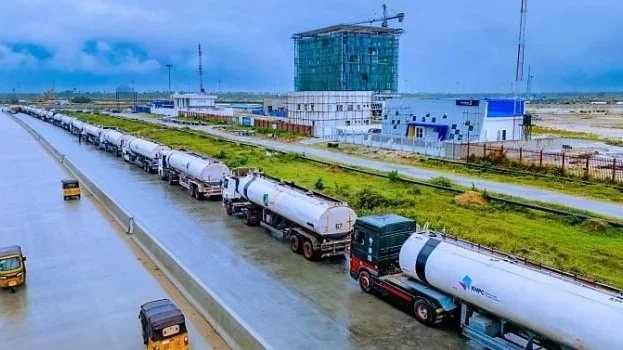
The refinery has also expanded its output and exports of petrol, diesel, aviation fuel and other refined petroleum products to African and international markets.
Global Refining Conditions Also Supported Earnings
Improved global refining margins contributed to the refinery's stronger financial performance.
Supply disruptions linked to geopolitical conflicts, including the Iran conflict and Russia-Ukraine war, have affected global refining capacity and fuel supply, supporting margins for some refined petroleum products.
Reuters reported that the refinery has benefited from the global disruptions while operating at high utilisation. However, the company has also said it expects fuel supply tightness to persist as damaged refining infrastructure is rebuilt and global inventories are replenished.
This means part of the refinery's recent earnings performance reflects favourable external market conditions as well as improvements in its own operating efficiency.
Crude Supply Remains a Key Risk
Despite the financial turnaround, the refinery continues to face challenges around crude feedstock.
About 60 per cent of its crude feedstock came from Nigerian grades in 2025, while the remainder was imported. Under its agreement with NNPC, the refinery has access to up to 350,000 barrels of crude per day, subject to availability.
This leaves the facility exposed to domestic crude supply constraints and the need to source additional feedstock internationally.
Reliable crude supply will become even more important if the company proceeds with its planned expansion.
Refinery Plans $14.27bn Expansion
Dangote plans to increase the refinery's capacity to 1.4 million barrels per day by 2029, effectively doubling its current processing capacity.
The expansion is estimated to cost $14.27 billion and is expected to include additional refining and petrochemical facilities.
The company says the expansion will increase production capacity and support greater import substitution for petroleum and petrochemical products.
The proposed expansion would position the facility among the world's largest single-site refineries if completed as planned.
₦2.15tn IPO Comes Amid Financial Turnaround
The improved financial performance comes as Dangote Refinery prepares to raise fresh capital through the Nigerian capital market.
The IPO seeks to raise approximately ₦2.15 trillion through the sale of 4.1 billion ordinary shares at ₦525 per share. The offer is scheduled to run from September 14 to October 13, 2026, with trading expected to begin later in November.
The IPO will give investors an opportunity to take equity exposure to one of Nigeria's largest industrial assets while providing the refinery with additional capital for its expansion plans.
The company had total indebtedness of $5.67 billion as of June 30, 2026, according to the figures reported from the IPO prospectus.
Potential Implications for Lagos Property Market
The refinery's financial and operational expansion could have wider implications for the Lagos property market, particularly around the Lekki and wider Lagos industrial corridor.
The facility's expansion is likely to sustain demand for industrial, logistics and commercial property linked to petroleum processing, distribution and supporting businesses.
Additional investment and employment generated by the refinery could also support demand for residential accommodation among workers, contractors and businesses operating within its wider supply chain.
However, the scale of the property-market impact will depend on the pace of the expansion, supporting infrastructure and the extent to which associated industrial activity develops around the refinery.
Industrial Infrastructure Could Drive Wider Investment
The refinery represents a significant concentration of industrial investment in the Lagos corridor.
Its operations require supporting infrastructure spanning logistics, transportation, storage, engineering, maintenance and distribution. Growth in these activities can create demand for warehouses, industrial parks, offices and other commercial facilities.
For property investors, this reinforces the importance of monitoring major industrial projects when assessing emerging real estate corridors.
However, infrastructure capacity, road connectivity, power supply and land availability will remain important factors in determining whether surrounding areas can absorb additional commercial and residential demand.
Outlook
Dangote Refinery's shift from nearly $2 billion in cumulative losses to $1.82 billion in first-half profit marks a significant change in the financial profile of the project.
The next test will be whether the refinery can sustain strong profitability under less favourable global refining conditions while securing sufficient crude supplies and managing the financing requirements of its planned expansion.
For Nigeria's wider economy and property market, the refinery's expansion could support industrial investment, employment and infrastructure demand, particularly across the Lagos corridor.
The upcoming IPO will provide another important test as the company seeks to turn its improved operating performance into long-term investor confidence and the capital required to expand its capacity.
READ MORE