Benin-Asaba Road Concession Faces Review as Highway Deteriorates
Federal Government Plans Concession Review Over Road Failure
The Federal Government is considering a review of the concession agreement for the Benin-Asaba Expressway after widespread deterioration of the highway triggered complaints from motorists and renewed scrutiny of the project’s execution.
/ You Might Also Like /




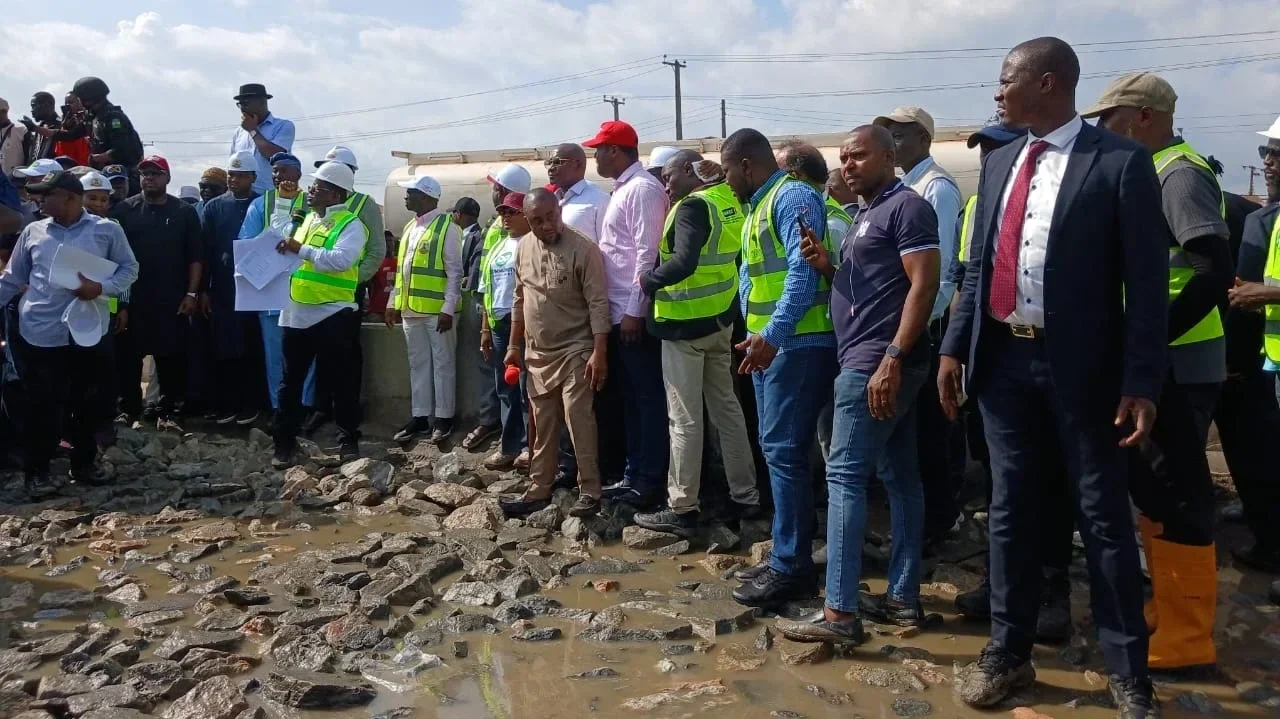
Minister of Works, David Umahi, disclosed this during an on-the-spot assessment of the highway in Benin, where he criticised the Benin-Asaba Expressway Concession Company (BAECC) over the handling of the project. The government said it would invoke the overriding public interest provision to intervene and restore sections of the road.
FG Faults Concessionaire Over Road Condition
Umahi expressed dissatisfaction with the concessionaire’s performance, particularly its decision to remove sections of existing asphalt before completing drainage infrastructure.
According to the minister, the Federal Government had cautioned the concessionaire against removing the existing road surface without first putting appropriate drainage systems in place.
The project consultant, Toyin Akinlapa, also said the concessionaire had been advised to construct the drainage infrastructure before removing the asphalt but did not follow the instruction.
The minister said the approach contributed to the worsening condition of the highway, particularly during the rainy season.
Government Considers Overriding Public Interest
Umahi said the government was considering using the overriding public interest provision to intervene in the concession.
He said Nigerians should not continue to experience hardship because of deficiencies in the existing concession arrangement and disclosed that competent contractors could be engaged to restore the affected sections of the road.
The Federal Government is also considering a broader review of the concession agreement, following the deterioration and complaints from road users.
The Chairman of the House of Representatives Committee on Works, Akin Alabi, similarly urged President Bola Tinubu to review the agreement and other similar concession arrangements.
Concessionaire Attributes Delays to Rainfall and Traffic
BAECC Chief Executive Officer, Samuel Daramola, attributed part of the slow progress to heavy rainfall and the volume of traffic on the highway.
He said the company had expanded portions of the road and carried out palliative works but faced difficulties completing drainage infrastructure while maintaining traffic movement.
The concessionaire maintained that it remained committed to completing the project despite the challenges.
The competing explanations have placed the execution of the concession under renewed scrutiny, particularly over whether the project’s construction sequence and traffic-management arrangements were adequate.
Benin-Asaba Road Was Concessioned in 2025
The Benin-Asaba Expressway forms part of the Federal Government’s highway development programme and was concessioned to BAECC for transformation into a 10-lane highway.
The 125-kilometre corridor was structured under a public-private partnership arrangement, with private-sector participation expected to finance and manage the development.
The current crisis has raised questions about how effectively concession agreements can balance private investment objectives with the government's responsibility to maintain safe and functional public infrastructure.
Road Failure Has Wider Economic Consequences
The condition of the Benin-Asaba highway has implications beyond motorists.
The corridor connects major commercial centres in Edo and Delta states and serves as an important route for the movement of people, agricultural produce and goods.
Poor road conditions can increase travel times, vehicle operating costs and logistics expenses for businesses. Prolonged disruption can also affect the movement of construction materials and other essential goods between markets.
For property markets, transport infrastructure plays an important role in determining the accessibility and attractiveness of locations along major corridors.
Property Development Depends on Reliable Infrastructure
The situation also highlights the relationship between infrastructure quality and real estate development.
Residential and commercial developments depend on reliable road networks to connect properties with employment centres, markets, schools and other services.
Where major transport corridors deteriorate, the resulting increase in travel time and transport costs can reduce the attractiveness of surrounding locations.
Conversely, successful reconstruction and expansion of the Benin-Asaba corridor could improve accessibility and support economic activity in communities along the route.
FG Plans Concrete Reconstruction of Other Roads
Umahi also disclosed that the Federal Government was considering redesigning roads from Kogi to Warri and other major roads around Edo State for reconstruction using concrete pavement.
He said some of the affected roads require complete reconstruction rather than continued palliative repairs.
The proposed approach reflects the government's wider push to address deteriorating federal road infrastructure through more durable reconstruction methods.
Concession Review Could Affect Future PPP Projects
The Benin-Asaba situation could also influence how future infrastructure concessions are structured and monitored.
Public-private partnerships are designed to mobilise private capital and expertise for infrastructure projects, but their effectiveness depends on clear performance requirements, technical capacity, monitoring mechanisms and enforcement provisions.
A review of the Benin-Asaba agreement could therefore provide an opportunity for the government to examine how concessionaires are selected, how construction milestones are monitored and what intervention mechanisms should apply when project performance falls below agreed standards.
Outlook
The Federal Government's decision to consider a review of the Benin-Asaba road concession marks a significant development in the management of Nigeria's major transport infrastructure.
The immediate priority remains restoring sections of the highway and reducing the hardship faced by motorists, while the proposed concession review could determine how the project proceeds under the existing public-private partnership framework.
For the construction and property sectors, the development reinforces the importance of reliable transport infrastructure to economic activity and real estate development. It also highlights the need for stronger oversight and accountability in infrastructure concessions to ensure that private-sector participation delivers sustainable public assets.
READ MORE