Tinubu Calls for End to Raw Mineral Exports as Africa Pushes for Local Value Addition
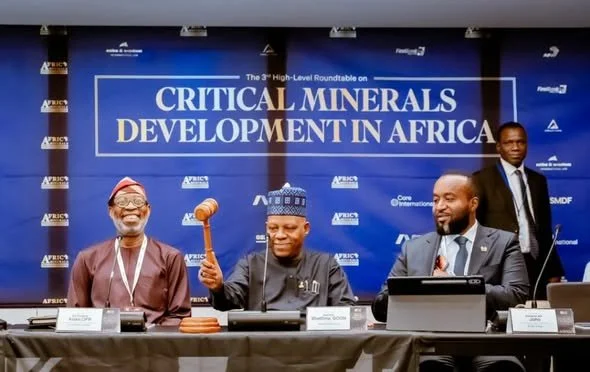
Tinubu pushes African mineral value addition
President Bola Tinubu has called on African countries to end the long-standing practice of exporting raw mineral resources and instead develop local processing, manufacturing and value-added industries capable of retaining more wealth within the continent.
Tinubu, represented by Vice-President Kashim Shettima, made the call at the third Africa Minerals Strategy Group (AMSG) High-Level Roundtable on Critical Minerals Development in Africa, held on the sidelines of the 81st Session of the United Nations General Assembly in New York.
/ You Might Also Like /




The roundtable, convened and chaired by Tinubu alongside Minister of Solid Minerals Development Dele Alake, focused on moving Africa's mineral resources from extraction towards processing, industrialisation and greater participation in global value chains.
Africa Seeks Greater Value From Mineral Resources
Tinubu argued that Africa's mineral wealth should generate greater economic benefits for African countries and communities rather than primarily serving as a source of raw materials for industries elsewhere.
He called for stronger cooperation among African countries to support local processing, manufacturing, technology transfer and skills development.
The President said the continent's mineral resources should contribute to jobs, infrastructure, industrial capacity and African enterprise participation.
The call comes as global demand for critical minerals increases, particularly because of their importance to clean energy technologies, advanced manufacturing and artificial intelligence-related supply chains.
Tinubu said Africa's response should include processing and refining facilities, battery production, component manufacturing and the development of African technologies and technical skills.
Raw Mineral Exports Limit Wider Economic Benefits
The push for local value addition reflects a broader concern about the structure of Africa's mineral trade.
Countries that export minerals primarily in raw form capture value at the extraction stage, while additional economic activity from processing, manufacturing and downstream industries takes place elsewhere.
Tinubu argued that African countries need to move towards an integrated mineral value chain in which extraction is linked to domestic processing and industrial production.
He also warned against African countries competing against one another through lower royalties, weaker local-content requirements and excessive concessions, arguing that fragmented approaches can weaken the continent's negotiating position.
Instead, he called for greater coordination in markets, financing, industrial development and negotiations with international investors.
Nigeria Highlights Mining Sector Reforms
Nigeria's mining sector was presented as an example of efforts to increase local participation and value creation.
Tinubu said revenue from the country's mining sector increased from approximately N6 billion in 2023 to more than N38 billion in 2024 and between N68.1 billion and N70 billion in 2025.
He also pointed to foreign investment commitments and the development and commissioning of large-scale lithium processing capacity in Nasarawa State as examples of the potential within the sector.
Nigeria's mining policy direction requires minerals extracted in the country to contribute to Nigerian industries, workers, skills development and host communities.
The President also identified stronger geological data, improved investor access, formalisation of artisanal mining through cooperatives, action against illegal mining and greater regulatory accountability as areas requiring attention.
Mineral Processing Could Increase Infrastructure Demand
The shift from raw mineral extraction to local processing would require significant infrastructure investment.
Processing plants, refineries, warehouses, power systems, water infrastructure, transportation networks and logistics facilities would be required to support expanded mineral value chains.
For Nigeria's property market, this could create opportunities in industrial real estate and infrastructure-linked development around mineral-processing locations.
Industrial parks, logistics centres and warehousing facilities could become increasingly relevant where mining operations develop into processing and manufacturing clusters.
The potential property impact, however, depends on the scale and sustainability of investment in mineral processing. A policy commitment to local value addition does not automatically translate into immediate demand for industrial property.
Strategic Mineral Corridors Require Investment
The AMSG roundtable also considered the creation of a more coordinated framework for Africa's strategic mineral corridors.
A Continental Integration and Economic Assurance Declaration was adopted at the meeting, with the stated objective of creating a predictable and investment-ready environment for strategic mineral value chains.
Tinubu said the declaration would need to move beyond the signing ceremony and be supported by timelines, financing arrangements, implementation mechanisms and public accountability.
Such corridors could have implications for infrastructure and property development if they connect mining locations with processing facilities, ports, power infrastructure and major markets.
For developers and investors, the emergence of integrated mineral corridors could create new locations for industrial, logistics and commercial development.
Financing Remains Critical to Local Processing
Local processing requires considerably more capital than simply extracting and exporting raw minerals.
African countries would need financing for processing plants, transportation infrastructure, power generation, research and development, technology acquisition and workforce development.
Tinubu called on development finance institutions and sovereign investors to develop financing platforms capable of supporting Africa's strategic mineral ambitions.
The availability and cost of long-term capital will therefore remain important to the success of the proposed transition.
Without adequate financing, local value-addition policies could struggle to translate into large-scale industrial capacity.
Mining Communities Also Need Infrastructure
The push for local value addition also has implications for communities located around mining operations.
Tinubu noted that many mineral-rich communities continue to face shortages of infrastructure and employment despite the economic value generated from resources extracted from their areas.
A more integrated mining model could increase pressure on governments and investors to provide roads, electricity, water, housing and other supporting infrastructure alongside industrial projects.
For the housing sector, mining and processing clusters could generate demand for worker accommodation and residential development where sustained employment and industrial activity increase local populations.
The scale of such demand would depend on the size of individual projects, employment levels and the extent to which supporting infrastructure is developed.
Africa Seeks Stronger Position in Global Supply Chains
The push for local processing is also connected to the strategic importance of critical minerals in global supply chains.
Minerals required for batteries, renewable energy systems and advanced technologies are becoming increasingly important to industrial economies.
Tinubu argued that Africa should use its mineral resources to build industrial capacity rather than remain primarily a supplier of raw materials.
The United Nations Secretary-General António Guterres similarly called for Africa's mineral wealth to create local value and jobs, saying critical minerals should be processed within Africa rather than simply shipped overseas as raw materials.
Outlook
Tinubu's intervention at the AMSG roundtable places local mineral processing, industrialisation and infrastructure development at the centre of Africa's strategy for capturing more value from its natural resources.
For Nigeria, the direction could have implications beyond the mining sector. Greater investment in mineral processing would require supporting infrastructure, logistics facilities, industrial parks, power systems and potentially new residential and commercial developments around emerging industrial centres.
The key challenge will be converting policy commitments into bankable projects supported by reliable infrastructure, long-term financing, transparent regulation and sufficient technical capacity.
If those conditions develop, the expansion of mineral processing could contribute to a broader industrial property market while strengthening economic activity around Nigeria's emerging mining and processing corridors.
READ MORE