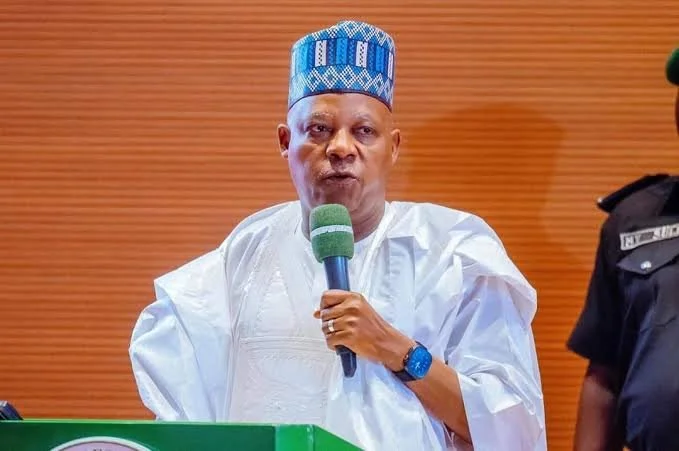
Vice-President Kashim Shettima has urged states to develop functional electricity markets and attract private investment
Vice-President Kashim Shettima has urged state governments to move beyond dependence on the Federal Government and take greater responsibility for addressing electricity shortages within their jurisdictions.
He said Nigeria’s ambition to build a competitive industrial economy would remain constrained unless electricity reforms delivered reliable power to businesses, households and public institutions.
/ You Might Also Like /




The Electricity Act 2023 provides a framework for states to develop and regulate electricity markets within their jurisdictions, creating opportunities to design power solutions around local demand, available resources and economic priorities.
Shettima warned, however, that passing legislation alone would not improve electricity supply. States must establish competent regulatory institutions and develop commercially viable markets capable of attracting investment.
Electricity Act Opens Opportunities for State-Level Power Markets
The Electricity Act 2023 allows states to establish electricity markets within the applicable legal framework, creating scope for greater participation in electricity generation, distribution and other intrastate operations.
The Nigerian Electricity Regulatory Commission (NERC) has transferred regulatory oversight to 17 states, with Akwa Ibom the latest to receive the transfer, according to the commission’s compliance representative, Hauwa Yakubu.
The transition brings regulatory responsibilities closer to state governments and could enable them to respond more directly to local electricity needs.
However, effective implementation requires more than the establishment of state electricity commissions. Regulators need technical expertise, adequate funding, transparent licensing procedures and the capacity to enforce standards and protect consumers.
States must also coordinate their electricity markets with the national grid, particularly where local supply continues to depend on electricity generated and transmitted through the national system.
States Encouraged to Mobilise Private Investment
Shettima said government funding alone could not meet Nigeria’s electricity infrastructure requirements, making private-sector investment essential to expanding supply.
He urged state governments to create predictable regulatory environments, establish commercially viable markets and strengthen investment safeguards. Transparent licensing, credible dispute-resolution mechanisms and clear rules could help reduce uncertainty for investors.
He also highlighted the potential to use different energy resources across the country. Sokoto, Borno and Katsina have solar-energy opportunities, while Delta, Rivers and Bayelsa have gas resources. Niger and Kebbi also offer hydroelectric potential.
Developing these resources could support electricity projects tailored to the needs of local communities and businesses, including renewable-energy schemes, distributed generation and mini-grids.
For states seeking to attract manufacturers, industrial operators and commercial enterprises, the ability to provide dependable electricity could become an important factor in investment decisions.
Proposed Framework to Track Electricity Reforms
To improve implementation, Shettima proposed a National Electricity Reform Peer Review and Implementation Framework involving NERC, the Federal Ministry of Power, the Nigeria Governors’ Forum and state electricity regulators.
The proposed voluntary framework would enable participating states to share experiences, identify implementation challenges and assess progress in electricity access, investment readiness, market development and consumer protection.
Annual reviews could also help states identify where they need technical support and learn from jurisdictions that have made progress in establishing functional electricity markets.
The proposal places emphasis on measurable outcomes rather than the mere existence of regulatory institutions. Relevant indicators include electricity generated, investments attracted, reliability of supply, jobs created and improvements in access to electricity.
The Nigeria Governors’ Forum is also working on a standard tariff framework intended to protect consumers while supporting investment and the commercial sustainability of state electricity markets.
Reliable Electricity Remains Important for Housing and Property Development
Electricity supply is a significant operating consideration for Nigeria’s property market. Developers, landlords, homeowners and commercial property operators face the costs associated with unreliable grid power, including expenditure on generators, fuel, maintenance and alternative energy systems.
For residential developments, dependable electricity can improve the usability and attractiveness of housing, while reducing the need for households to rely heavily on individual backup systems. For commercial buildings and industrial properties, power reliability can influence operating costs, tenant demand and investment decisions.
State-level electricity markets could create opportunities to develop dedicated power solutions for housing estates, industrial parks, commercial districts and underserved communities. These could include embedded generation, renewable-energy installations and mini-grids, where legally permitted and commercially viable.
However, the impact on property development will depend on whether the reforms translate into reliable supply at affordable rates. Electricity market decentralisation does not automatically guarantee lower tariffs or eliminate supply constraints.
States will need to coordinate energy planning with urban development, housing delivery and industrial policy to ensure that new power investments support the locations and communities where demand is growing.
Consumer Protection and Regulatory Clarity Remain Essential
Shettima called for stronger safeguards against arbitrary billing, poor service and unfair commercial practices, stressing that electricity operators should be accountable for the quality of service they provide.
Effective regulation will be important as more states establish their own electricity markets. Consumers and investors need clarity on tariffs, licensing requirements, service standards, complaint-resolution processes and the responsibilities of federal and state institutions.
Uncertainty over regulatory authority could delay projects, raise compliance costs and discourage investment. Conversely, predictable rules and effective coordination could help electricity providers plan infrastructure spending and secure financing.
The transition must also account for existing contracts and financial obligations, which do not automatically disappear when regulatory responsibilities change.
Implementation Will Determine the Success of Electricity Reform
The Federal Government’s message places greater responsibility on states to convert the opportunities created by the Electricity Act 2023 into practical improvements in electricity access and reliability.
The proposed peer-review framework could support this process by encouraging states to share experience, identify weaknesses and monitor progress. Its effectiveness will depend on participation, credible performance measures and the willingness of governments to act on the findings.
For Nigeria’s housing and real estate sector, the key issue is whether decentralised electricity markets can deliver more dependable and commercially sustainable power to residential communities, businesses and industrial developments.
The success of the reforms will ultimately be measured by improved electricity supply, stronger investment and lower operational uncertainty for consumers and businesses—not simply by the number of state electricity regulators established.
READ MORE