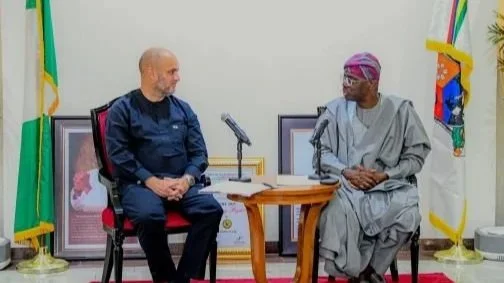
Nigerian and French business representatives discuss trade
Nigeria’s economic relationship with France is extending across infrastructure, energy, transport, logistics and agriculture, with bilateral trade reaching $4.7 billion in 2025 and French foreign direct investment stock in Nigeria standing at €8.1 billion.
The figures highlight the scale of commercial ties between both countries as businesses seek opportunities in Nigeria’s infrastructure and consumer markets. More than 100 French companies operate in Nigeria across sectors including pharmaceuticals, insurance, agriculture, hospitality, logistics and transport, generating approximately 14,000 direct local jobs.
/ You Might Also Like /




The figures were highlighted by France’s Consul General in Lagos, Laurent Favier, and the President of the Franco-Nigerian Chamber of Commerce and Industry (FNCCI), Guillaume Niarfeix, ahead of the 2026 French Week programme.
The initiative aims to strengthen business engagement and turn discussions between companies into commercial partnerships. However, the wider economic significance will depend on how existing investments and proposed agreements translate into completed projects, jobs and productive capacity.
Infrastructure and Transport Projects Drive Commercial Cooperation
Infrastructure forms a significant part of the expanding relationship. Agreements advanced in Paris in September 2026 included plans for the Gateway Deep Sea Port and the adjoining Ogun State Blue Marine Special Economic Zone.
The projects could support trade and industrial activity by improving logistics capacity and creating opportunities for businesses operating around the port and associated economic zone. Their eventual impact will depend on project financing, implementation, supporting infrastructure and the level of private-sector activity they attract.
In Lagos, the Omi Eko water-transport project is another major initiative involving French development support alongside the European Union and the European Investment Bank.
The project plans to introduce 75 electric ferries, upgrade 25 terminals and establish 15 routes covering 140 kilometres of waterways. If delivered as planned, the network could expand public transport options, improve connections between communities and reduce pressure on some road corridors.
For property markets, improved transport connectivity can influence accessibility and the attractiveness of residential and commercial locations. However, any effect on land values, rents or development activity will depend on where services operate, how reliable they become and whether supporting infrastructure keeps pace.
The Lekki Deep Sea Port also features in the commercial relationship. CMA CGM has agreed to operate its container terminal, while the port has a reported annual handling capacity of 2.5 million twenty-foot equivalent units. Increased port activity could support demand for industrial premises, warehouses and logistics facilities, although actual demand will depend on cargo volumes and the growth of related businesses.
Energy Investment and Industrial Development
Energy remains another important area of cooperation. TotalEnergies’ investment decisions involving the Ubeta gas field and the more recent IMA project form part of ongoing activity in Nigeria’s energy sector.
The Ubeta field is intended to supply gas to Nigeria LNG’s Train 7 project, linking upstream production to the country’s gas-export capacity.
Other French companies, including SPIE and Schneider Electric, operate in sectors connected to energy and infrastructure services. Their activities reflect the range of commercial interests extending beyond traditional energy trade.
For Nigerian businesses, reliable energy infrastructure can influence operating expenses, investment decisions and the viability of industrial development. For property developers, stronger power and transport networks can improve the prospects of locations that currently face high operating costs or weak infrastructure.
These benefits are not automatic. Project execution, supply reliability and the availability of supporting networks will determine whether investment commitments translate into measurable improvements for businesses and surrounding communities.
Agricultural Investment and Private-Sector Expansion
The relationship also covers agriculture and food processing. The Franco-Nigerian Agri-Business Club aims to encourage collaboration in agricultural mechanisation, local capacity building, agro-processing and efforts to reduce post-harvest losses.
The initiative could support investment in processing facilities, storage infrastructure and agricultural supply chains if it leads to funded projects and sustained commercial partnerships.
Nigerian businesses are also pursuing opportunities in France. JR Farms and Babafood have established activities in the French market across areas including agricultural production, exports and agro-industrial trade. The Flour Mills of Nigeria Group has also expressed interest in expanding its presence there.
In technology, Nigerian start-up GecX60 has established a research and development centre within an Orange Group incubator in Blagnac, France, while Convexity is preparing to establish a European office in Paris.
These developments show that commercial engagement is not limited to French companies entering Nigeria. Nigerian firms are also seeking access to European markets, investors and business networks.
Investment Figures Must Translate into Measurable Outcomes
The reported €8.1 billion in French foreign direct investment stock in Nigeria in 2025 provides an indication of the accumulated investment relationship. However, the figure does not represent new investment made during 2025 alone.
Likewise, bilateral trade of $4.7 billion measures commercial exchange rather than the amount of new capital invested in Nigerian projects. Trade volumes, investment stock and newly announced project commitments are different indicators and should not be treated as interchangeable.
For Nigeria, the key question is whether the expanding relationship generates additional productive investment, local employment, technology transfer and infrastructure that supports economic activity.
The same test applies to projects with potential property-market implications. Port developments, transport networks and industrial investment can create opportunities for developers and investors, but the scale of those opportunities will depend on delivery schedules, financing, occupancy and business demand.
The 2026 French Week programme is intended to strengthen engagement between Nigerian and French businesses and identify further areas of cooperation. Its value will ultimately depend on whether those discussions produce concrete agreements and projects that progress beyond announcements.
For investors and businesses, the relationship presents opportunities across infrastructure, logistics, energy and agribusiness. The next measure of progress will be the conversion of those opportunities into completed assets and sustained economic activity.
READ MORE