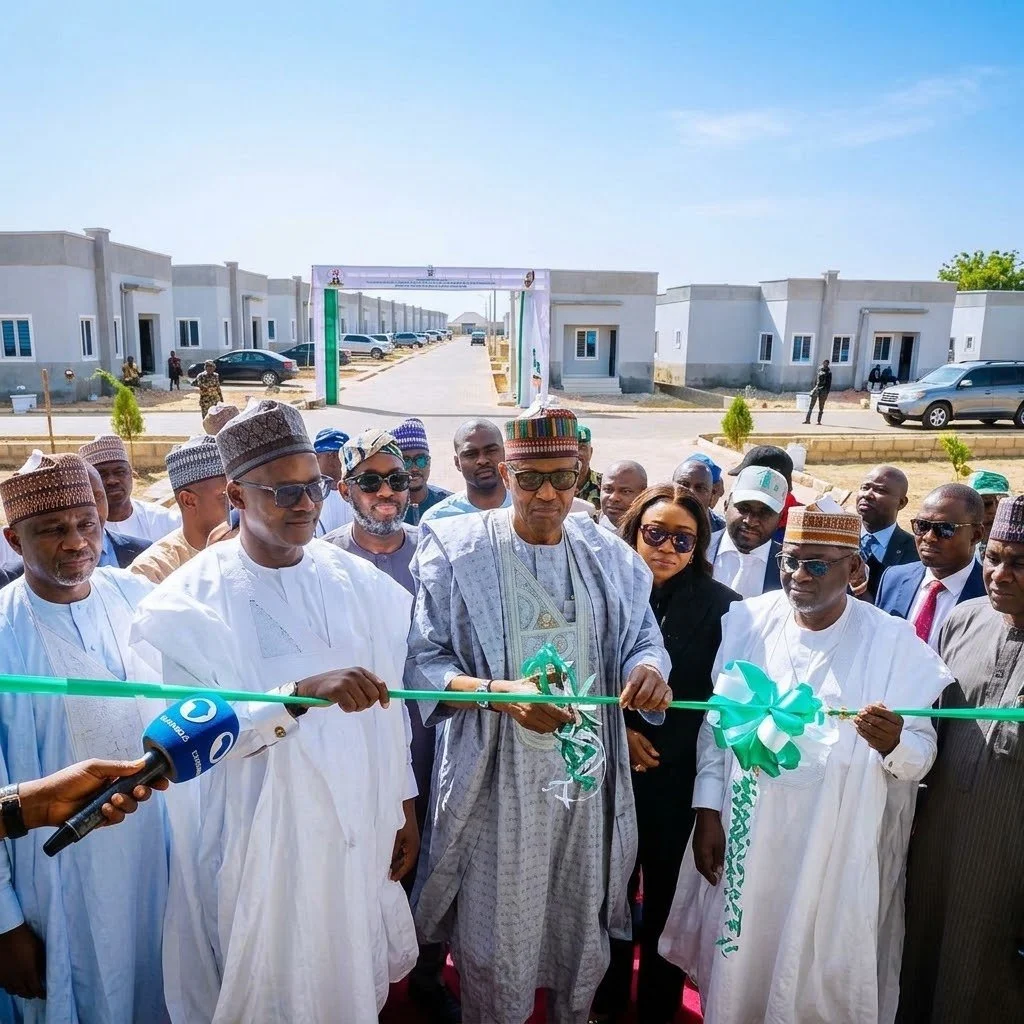
FMBN hands over keys to the first beneficiaries
The Federal Mortgage Bank of Nigeria (FMBN) has launched a non-interest lease-to-own housing scheme for eligible National Housing Fund (NHF) contributors, opening another route to homeownership as the bank seeks to widen access to mortgage finance.
/ You Might Also Like /




The product, known as Ijarah Muntahia Bittamleek, was formally launched by the Minister of Housing and Urban Development, Muttaqha Rabe Darma, in Kano on 27 October 2026. As part of the launch, FMBN commissioned the FMBN-Ijarah-01 Estate in Bichi and handed over keys to the first beneficiaries.
The scheme allows eligible participants to occupy a property through a lease arrangement and acquire ownership after fulfilling the agreed contractual obligations. It offers an alternative to conventional interest-based mortgage financing and is open to qualifying NHF contributors regardless of their religious affiliation.
The launch comes as Nigeria seeks to expand mortgage access beyond the relatively small number of households able to secure conventional housing loans. However, the scheme’s wider impact will depend on its affordability, eligibility requirements and the number of homes it makes available to contributors.
How FMBN’s Lease-to-Own Scheme Works
Ijarah Muntahia Bittamleek is a non-interest financing arrangement under which a property is leased to a customer, with ownership transferred at the end of the agreed term once the customer fulfils the contract.
Rather than relying on a conventional interest-bearing mortgage, the arrangement uses lease payments and agreed conditions governing the eventual transfer of the property.
FMBN says the product is designed to accommodate eligible NHF contributors seeking an alternative to conventional mortgage financing. It complements the bank’s existing housing-finance offerings and aims to widen participation in the mortgage market.
However, the launch announcement did not disclose the complete financing terms, including the lease duration, payment schedule, property prices, income thresholds or the full application process. These details will be important in determining whether the scheme is affordable to low- and middle-income earners.
Prospective applicants should confirm the current eligibility requirements and contractual terms directly with FMBN before making financial commitments.
First Beneficiaries Receive Homes in Kano
The launch included the commissioning of the FMBN-Ijarah-01 Estate in Bichi Local Government Area of Kano State.
Developed by AYAB Construction Company, the estate comprises two- and three-bedroom bungalows supported by infrastructure and essential facilities. FMBN handed over keys to the first beneficiaries as part of the pilot implementation.
The handover provides an initial example of the scheme translating from a financing product into housing delivery. Its longer-term performance will depend on how many eligible contributors secure homes through the arrangement and whether FMBN can replicate the model in other locations.
The housing minister urged the bank to extend the scheme beyond Kano to cities including Lagos, Port Harcourt, Enugu, Ibadan, Maiduguri, Sokoto and Abuja.
A broader rollout could expand access to housing finance, but it will require suitable housing supply, transparent financing terms and an application process that contributors can navigate.
Six Million NHF Contributors Represent a Potential Market
Nigeria’s National Housing Fund provides a framework for mobilising contributions towards housing finance. The housing minister said more than six million Nigerians contribute to the scheme, although FMBN has historically booked fewer than 500 individual mortgages annually.
The gap highlights the challenge of converting participation in the NHF into actual homeownership. The new lease-to-own product seeks to broaden the options available to contributors who may not wish to use interest-based financing.
The Federal Government’s National Mortgage Industry Policy also sets wider targets for expanding mortgage access. These include increasing the maximum FMBN loan limit from ₦50 million to ₦85 million, targeting 2,000 mortgages in 2026 and 5,000 annually by 2028, and processing applications within 30 working days under a simplified eight-document requirement.
The policy further targets an increase in NHF membership from six million to 10 million by 2028.
These are policy targets rather than confirmed outcomes. The number of contributors who eventually receive mortgages, the value of loans disbursed and the homes delivered will provide a clearer measure of progress.
Affordability Will Determine the Scheme’s Reach
The introduction of a non-interest mortgage option does not automatically make homeownership affordable. Property prices, household incomes, payment schedules and the availability of homes will determine who can use the scheme.
For low- and middle-income households, a workable lease-to-own arrangement must offer payments they can sustain while covering food, transport, utilities and other living expenses. Applicants also need clear information about their contractual obligations, the conditions for transferring ownership and the consequences of missed payments.
The scheme could also create another route for developers to connect completed housing units with eligible buyers. However, its value to the wider housing market will depend on whether FMBN can support delivery at meaningful scale and provide access to homes in locations where contributors need them.
For policymakers, the central challenge is to ensure that the product reaches households that face barriers to conventional mortgages, rather than merely adding another financing option with limited availability.
FMBN Faces the Test of Delivery at Scale
The lease-to-own launch follows FMBN’s introduction of a diaspora mortgage product in August 2026 and its broader efforts to expand housing finance.
The bank reported approving more than ₦208 billion in housing and mortgage loans in 2025, while disbursements exceeded ₦120 billion across housing construction, mortgage financing, renovation and other housing-related activities. It also reported financing 6,911 affordable housing units during the year.
Those figures provide context for the bank’s activities, but loan approvals, actual disbursements, completed homes and homes handed over to beneficiaries represent different stages of delivery. The new lease-to-own scheme will need to be assessed on its own results.
The next milestones include publishing the detailed financing terms, clarifying eligibility and application procedures, expanding the scheme beyond its initial Kano pilot and reporting how many contributors secure homes through it.
FMBN’s launch adds another option to Nigeria’s housing-finance system. Its real significance will depend on whether eligible contributors can afford the payments, access suitable homes and complete the process of acquiring ownership.
READ MORE