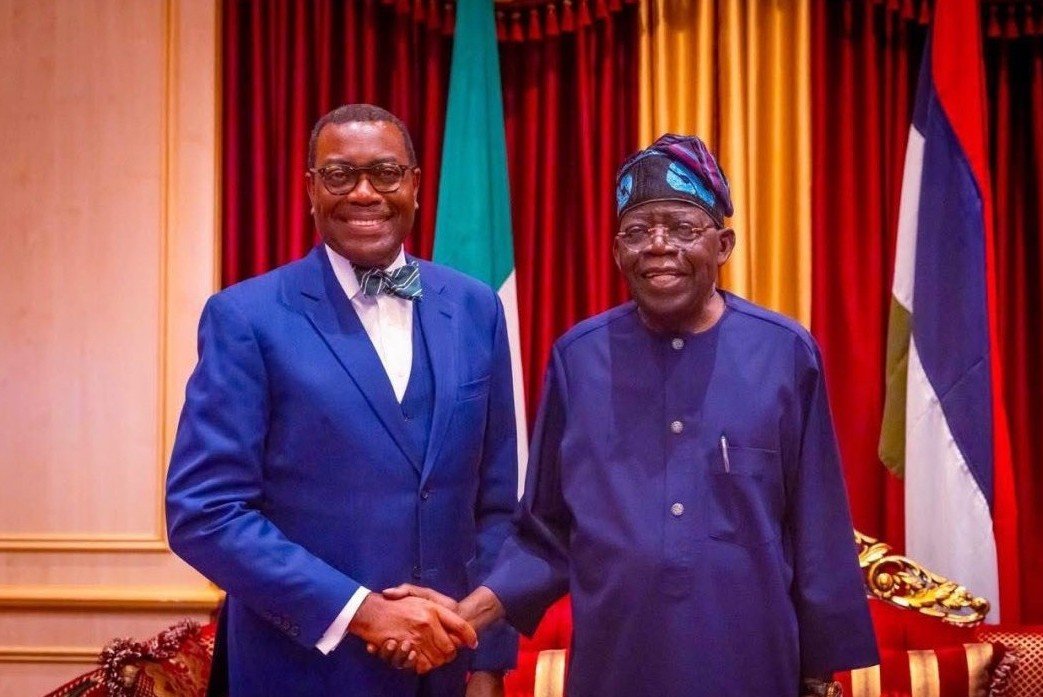
Former African Development Bank president Akinwumi Adesina meets President Bola Tinubu
Former African Development Bank (AfDB) president Akinwumi Adesina has urged Nigeria to move beyond economic stabilisation and focus on structural transformation, economic growth and prosperity following a meeting with President Bola Tinubu in Abuja.
Adesina made the remarks on 27 October 2026 after meeting Tinubu at the Presidential Villa, where he briefed the president on his decade leading the continental development finance institution and its financial support for Nigeria.
/ You Might Also Like /




The former AfDB president also offered to contribute to Nigeria’s development in any capacity the president considered appropriate. He stressed, however, that he was not seeking a government appointment.
His comments come as Nigeria continues to navigate the effects of major economic reforms, including petrol subsidy removal and changes to the foreign exchange market. While Adesina said these measures were beginning to produce results, he acknowledged that the cost of goods and services remained high.
AfDB Provided $7bn to Nigeria Between 2015 and 2025
Adesina said the AfDB provided approximately $7 billion in financing to Nigeria between 2015 and 2025. That amount represented about 63% of the $11.1 billion the bank had financed in Nigeria since beginning operations in the country in 1971.
The figures highlight the scale of the bank’s financial involvement in Nigeria during Adesina’s tenure, which began in 2015 and ended after two five-year terms.
Development finance institutions can support projects that require substantial long-term funding, including infrastructure, agriculture, energy and private-sector development. Their impact, however, depends on how financing translates into completed projects, productive capacity and measurable economic benefits.
For Nigeria, the next challenge is to ensure that development funding supports sustainable economic activity, improves infrastructure and strengthens the conditions for private investment.
Adesina Calls for Shift from Stabilisation to Economic Growth
Adesina described the removal of the petrol subsidy and the harmonisation of foreign exchange windows as difficult but important reforms. He said foreign exchange availability had improved, portfolio investors were returning and inflation was trending downwards.
He also pointed to more favourable assessments from some international credit rating agencies as signs of a changing perception of Nigeria’s economy.
However, Adesina cautioned that stabilisation was only the beginning. He argued that Nigeria must now focus on structural transformation and broader economic growth.
That shift would require more than improvements in headline economic indicators. Sustained growth depends on stronger productive capacity, reliable infrastructure, investment, employment creation and policies that help businesses expand.
For property developers and investors, these factors influence construction costs, access to finance, demand for commercial space and the viability of residential developments. Improved macroeconomic conditions can support investment, but they do not automatically translate into more affordable housing or increased property delivery.
No Government Appointment Announced
During the meeting, Adesina said he was ready to support Nigeria wherever his experience could be useful. He framed the offer as a responsibility to his country rather than a request for public office.
No specific role or appointment was announced following the meeting.
His experience includes leading the AfDB for a decade and previously serving as Nigeria’s minister of agriculture and rural development from 2011 to 2015. His work in development finance and agricultural policy has involved initiatives aimed at expanding investment, strengthening food security and supporting economic development.
Whether he takes on a formal advisory or other role in Nigeria remains unclear. Any future contribution would need to be assessed against the responsibilities assigned to him and the results delivered.
Infrastructure and Investment Remain Key to Nigeria’s Next Phase
Nigeria’s transition from economic stabilisation to sustained growth will depend partly on its ability to expand infrastructure, attract productive investment and improve conditions for businesses.
Infrastructure gaps raise operating costs across the economy. In the property sector, unreliable electricity, inadequate transport links and limited supporting services can increase development expenses and reduce the attractiveness of locations for residential, commercial and industrial projects.
Long-term development financing can help address these constraints, but funding alone is insufficient. Effective project selection, implementation, transparency and maintenance also determine whether investment generates lasting benefits.
Adesina’s comments place the focus on the next stage of Nigeria’s economic agenda: converting reform measures and financing into broader growth and improved living standards. For the housing and real estate sector, the practical test will be whether that transition creates more favourable conditions for development, investment and the delivery of homes and infrastructure.
READ MORE