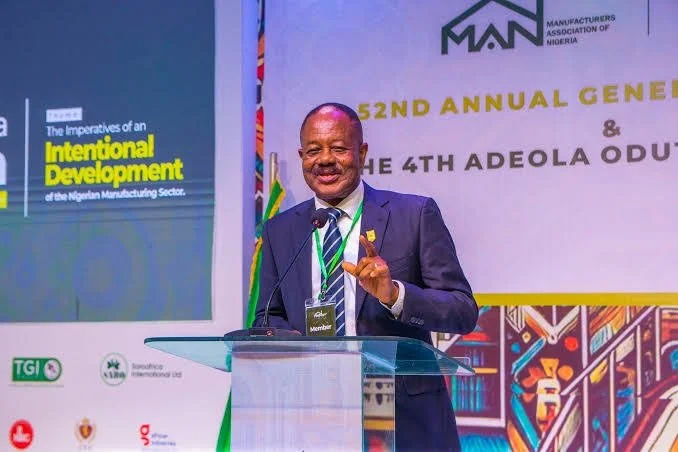
Dr Ifeanyi Eric Okoye, chief executive of Juhel Nigeria Limited
The Manufacturers Association of Nigeria (MAN) has elected Dr Ifeanyi Eric Okoye, chief executive of pharmaceutical manufacturer Juhel Nigeria Limited, as its 12th president, placing an industry executive at the head of the country’s leading manufacturers’ association as businesses contend with high production costs, infrastructure gaps and financing constraints.
/ You Might Also Like /




Okoye emerged at MAN’s 54th Annual General Meeting, held on 7 October 2026 at the Lagos Oriental Hotel. He succeeds Otunba Francis Meshioye, who completed a four-year tenure.
His appointment comes at a challenging time for Nigerian industry, with manufacturers facing pressure from energy costs, foreign-exchange conditions, expensive credit and weaknesses in transport and other infrastructure. MAN plays a central role in representing manufacturers’ interests and engaging government on policies affecting industrial investment and competitiveness.
The new president’s priorities and engagement with policymakers will therefore be important to manufacturers seeking a more predictable operating environment and better conditions for investment and expansion.
Okoye Brings Pharmaceutical Manufacturing Experience
Okoye founded Juhel Nigeria Limited in 1987. The wholly indigenous pharmaceutical company is headquartered in Enugu and has expanded its manufacturing operations over several decades.
The company moved to its permanent site in Emene, Enugu, in December 1989, added syrup and capsule production facilities in 2001, and opened a major parenteral manufacturing facility in Awka, Anambra State, in 2010.
Okoye holds a pharmacy degree from the University of Ife, now Obafemi Awolowo University, as well as a master’s degree and a PhD in Pharmaceutical Technology and Industrial Pharmacy from the University of Nigeria, Nsukka. He is a Fellow of the Pharmaceutical Society of Nigeria and an alumnus of Harvard Business School. He received the national honour of Officer of the Order of the Federal Republic in 2012.
His experience in manufacturing comes alongside a long history of involvement in MAN. He chaired the association’s Enugu, Anambra and Ebonyi state branches between 1998 and 2005, and served as vice-president from 2006 to 2010.
He also served on the Governing Council of the Standards Organisation of Nigeria from 2009 to 2022 and participated in a ministerial committee on establishing world-class hospitals and diagnostic centres between 2013 and 2015.
Manufacturers Face High Costs and Infrastructure Constraints
MAN represents businesses across Nigeria’s manufacturing sector and provides a platform for engagement with government, regulators and other stakeholders on industrial policy.
Manufacturers continue to face operating challenges that affect production, investment and competitiveness. High energy and logistics costs can raise the cost of locally made goods, while foreign-exchange pressures can make imported machinery, raw materials and spare parts more expensive. Access to affordable long-term financing also remains important for businesses seeking to expand production capacity.
These constraints have wider economic implications because manufacturing supports employment, local supply chains and demand for infrastructure and commercial property.
For the construction and real estate sectors, stronger domestic manufacturing can improve the availability of locally produced building materials and other inputs. However, any reduction in construction costs would depend on the performance of individual industries, production capacity, energy reliability, transport costs and competition.
Policy Engagement Will Shape MAN’s Next Phase
MAN’s ability to represent manufacturers effectively will depend partly on how it engages policymakers on the conditions affecting industrial production. Key issues include electricity supply, access to finance, taxation, foreign-exchange stability, trade policy and the cost of moving goods across the country.
The association’s advocacy can help communicate industry concerns and propose policy changes, although actual improvements will depend on government decisions and implementation.
For investors, the operating environment remains an important consideration when evaluating manufacturing expansion and the viability of new projects. More predictable policies and reliable infrastructure can support capital investment, while persistent cost pressures can delay expansion or weaken competitiveness.
Okoye’s presidency begins with these longstanding challenges still facing the sector. The extent to which his leadership translates into measurable improvements for manufacturers will become clearer through MAN’s policy priorities, its engagement with government and the outcomes achieved for businesses across its membership.
READ MORE