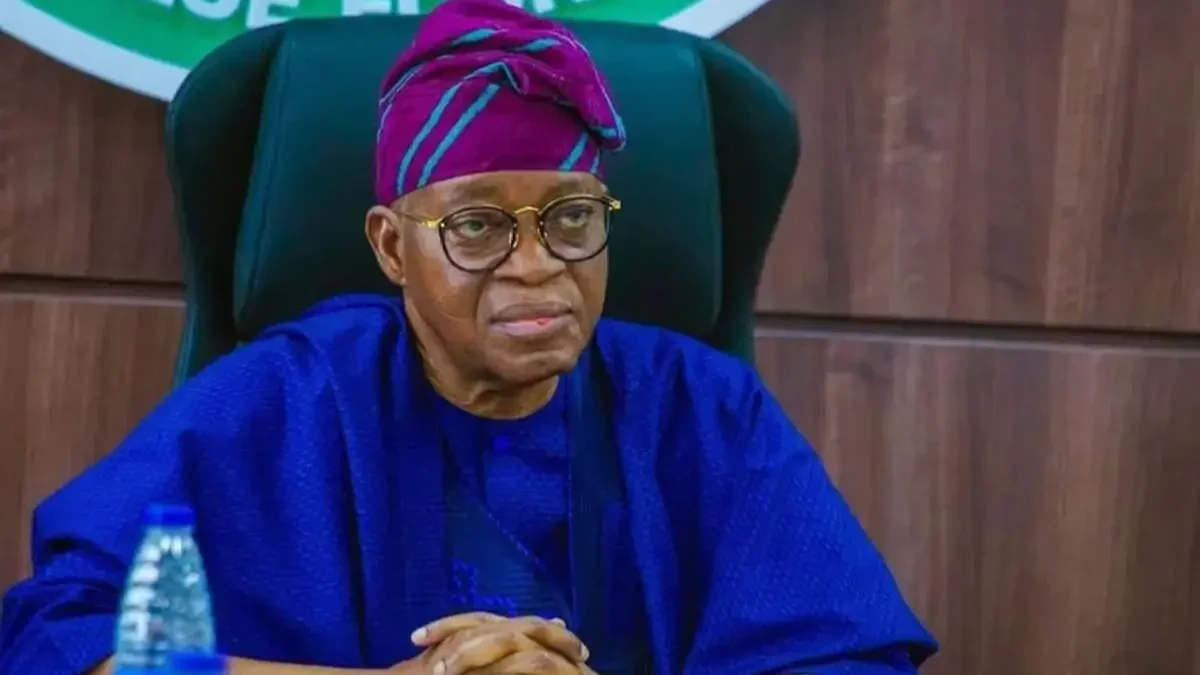
Adegboyega Oyetola
The Federal Government has commenced disbursement of the Cabotage Vessel Financing Fund (CVFF) to qualified Nigerian shipowners, marking a significant step towards strengthening indigenous participation in the country's maritime industry after more than two decades of delays.
/ You Might Also Like /




Minister of Marine and Blue Economy, Adegboyega Oyetola, disclosed the development on Thursday, October 29, 2026, at the 2026 Annual Summit of the Shipping Correspondents Association of Nigeria (SCAN) in Lagos. The initiative aims to help local shipping operators acquire modern vessels, expand their fleets and improve their ability to compete in the domestic maritime market.
The funding is also expected to address longstanding financing constraints that have prevented many indigenous shipowners from expanding their operations, particularly high borrowing costs, stringent collateral requirements and the substantial capital required to acquire and maintain commercial vessels.
FG Moves to Strengthen Indigenous Shipping Capacity
Oyetola said the government remained committed to increasing Nigerian participation in the maritime sector, retaining more industry value within the domestic economy and creating sustainable employment opportunities.
Represented at the summit by Anastasia Ogbonna, Director of Media at the Federal Ministry of Marine and Blue Economy, the minister said the government had directed the Nigerian Maritime Administration and Safety Agency (NIMASA) to commence the disbursement process for qualified beneficiaries.
He explained that the government had also taken steps to improve access to the financing scheme by introducing a dedicated application portal in January 2026 and increasing the number of approved Primary Lending Institutions (PLIs) from five to 12.
The expanded network of participating financial institutions is intended to improve access to funding and make the application and assessment process more accessible to eligible operators.
The minister described the CVFF as a strategic financing instrument for supporting vessel acquisition, expanding indigenous fleets and stimulating investment in related maritime industries, including ship repair, marine engineering and maritime logistics.
He also urged financial institutions to develop financing products that reflect the industry's operational requirements while encouraging shipowners to maintain strong corporate governance, responsible borrowing practices and effective fleet management.
CVFF Targets Vessel Acquisition and Maritime Investment
Established under Nigeria's Coastal and Inland Shipping (Cabotage) Act of 2003, the Cabotage Vessel Financing Fund provides financial assistance to eligible Nigerian shipping companies seeking to acquire vessels and participate more actively in domestic coastal shipping.
The scheme operates through approved financial institutions, which assess applications and facilitate financing for qualified operators. Under the framework, the fund supports vessel acquisition and refinancing, subject to established eligibility and lending requirements.
The government expects the financing initiative to increase the number of vessels owned and operated by Nigerians, improve the competitiveness of local shipping companies and reduce the country's dependence on foreign-owned vessels for domestic maritime operations.
A stronger indigenous shipping fleet could also create opportunities across supporting industries. Shipyards, marine engineering companies, equipment suppliers and maritime logistics operators stand to benefit from increased vessel acquisition and maintenance activities.
Oyetola projected that the initiative could generate more than 30,000 direct and indirect jobs across these industries, although the actual employment impact will depend on the scale of financing deployed and the pace of expansion in indigenous shipping operations.
The minister also disclosed that the government was exploring the establishment of a commercially driven national shipping line through a public-private partnership (PPP), signalling an additional effort to attract private investment into the maritime sector.
Fund Disbursement Follows Years of Delays
The commencement of disbursement represents a major development for a financing scheme that remained inaccessible to Nigerian shipowners for more than two decades after its establishment.
Although successive administrations announced plans to release the fund, administrative delays, concerns about transparency and questions surrounding its management repeatedly slowed implementation.
In December 2019, the Federal Government announced that indigenous shipowners would begin accessing the fund in January 2020 following approval by former President Muhammadu Buhari. At the time, the fund reportedly stood at ₦44.64 billion.
However, the planned rollout encountered further difficulties in May 2023 when the House of Representatives ordered its suspension over concerns about the availability of reliable information on the fund's accumulated balance and the absence of clear beneficiary records.
The National Assembly subsequently approved the release of an estimated $360 million to qualified Nigerian shipowners following an investigation.
Renewed efforts to operationalise the scheme gathered momentum in April 2025 when NIMASA announced plans to commence disbursement. The process advanced further with the introduction of the dedicated application portal on January 22, 2026.
In September 2026, President Bola Tinubu approved the disbursement, directing NIMASA and the participating financial institutions to accelerate the process.
At the time, Oyetola disclosed that NIMASA had received 92 applications under the scheme. Twenty applications had been submitted to participating lending institutions, while one had undergone review and advanced for final approval.
The latest announcement indicates that the government has moved beyond the approval and application stages towards actual implementation.
Financial Institutions and Industry Stakeholders Expected to Support Implementation
The successful deployment of the CVFF will depend on effective collaboration between NIMASA, participating financial institutions and indigenous shipping companies.
At the summit, UBA Apapa Regional Manager Nelson Edoye reaffirmed the bank's commitment to supporting local participation in the maritime value chain through tailored financing and trade facilitation solutions.
Meanwhile, SCAN President Moses Ebosele called for a comprehensive strategy to address the financial, regulatory and infrastructure constraints facing Nigerian shipowners.
He identified high operating costs, multiple industry charges, inconsistent policies and inadequate maritime infrastructure as persistent obstacles to the development of indigenous shipping capacity.
Ebosele maintained that expanding local vessel ownership would help Nigeria retain more maritime revenue, create employment, support local shipbuilding and strengthen its economic independence.
These concerns highlight the importance of complementing access to financing with broader improvements in the operating environment. Vessel acquisition alone may not guarantee the long-term competitiveness of Nigerian shipping companies without affordable operating costs, reliable infrastructure and a predictable regulatory framework.
Outlook for Nigeria's Maritime Industry
The commencement of CVFF disbursement marks an important milestone in the Federal Government's efforts to strengthen indigenous shipping capacity and increase local investment in the maritime sector.
The scheme could improve access to long-term financing, encourage vessel acquisition and stimulate activity across ship repair, marine engineering and maritime logistics. However, its long-term effectiveness will depend on transparent fund administration, responsible lending, timely disbursement and the ability of beneficiaries to repay their facilities.
For Nigeria's maritime industry, the immediate priority will be translating the government's financing commitment into operational vessels, stronger local shipping companies and measurable growth in domestic participation.
READ MORE