Dangote Refinery IPO signing ceremony in Lagos
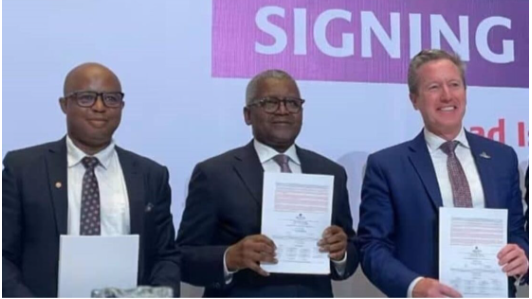
Dangote Petroleum Refinery and its appointed investment banks have signed the registration and offering documents for a ₦2.15 trillion initial public offering (IPO), moving the landmark share sale closer to its September 14 launch.
The signing ceremony took place in Lagos on September 7, bringing together Dangote Group executives, financial advisers and other parties involved in the offer. The IPO is expected to become one of the largest capital-market transactions in Africa
/ You Might Also Like /




The approved offer comprises 4.1 billion ordinary shares priced at ₦525 each, with the transaction targeting approximately ₦2.15 trillion if fully subscribed.
IPO Targets Wider Nigerian Investor Participation
The refinery's share offer is designed to attract a broad range of investors, including retail investors.
Reports indicate that the transaction is targeting up to 10 million investors, while the minimum subscription has been set at 10 shares. This would allow smaller investors to participate in ownership of one of Africa's largest industrial assets.
The planned offering represents a significant test of the depth of Nigeria's capital market and its ability to mobilise domestic savings into large-scale productive assets.
The IPO is also expected to give Nigerian investors greater exposure to the performance of the country's refining and downstream petroleum sector.
Dangote Plans Major Refinery Expansion
The IPO comes as Dangote Refinery prepares for a major expansion programme.
The company has announced plans to invest about $14.3 billion to increase the refinery's processing capacity from 650,000 barrels per day to 1.4 million barrels per day by 2029.
The planned expansion is expected to support additional infrastructure around the refinery, including storage facilities and other assets required to expand its regional distribution network.
The company has also outlined plans for further refining investments outside Nigeria, including a proposed refinery project in Kenya.
Refinery Already Has Major Economic Significance
Located within the Lekki Free Zone in Lagos, the Dangote Refinery has a nameplate capacity of 650,000 barrels per day and was developed at an estimated cost of $20 billion. It began operations in 2024.
The facility has changed Nigeria's position in the petroleum-products market by increasing domestic refining capacity and creating the potential for greater exports of refined products to other African markets.
The refinery's expansion could further increase activity around the Lekki corridor, where industrial, logistics, commercial and residential development has already accelerated.
IPO Could Deepen Nigeria's Capital Market
The size of the transaction makes the Dangote Refinery IPO particularly significant for Nigeria's capital market.
The offer provides an opportunity to channel domestic and international investment into a large productive asset rather than relying exclusively on bank financing or private capital.
A successful transaction could also demonstrate the capacity of Nigeria's equity market to absorb large-scale listings and encourage other major privately held businesses to consider public-market funding.
For institutional investors, the IPO provides exposure to an energy asset with substantial domestic and regional market significance.
Lekki Property Market Could Benefit From Expansion
The refinery's continued expansion also has implications for the property market, particularly around the Lekki Free Zone and neighbouring communities.
Large industrial investments typically generate demand for worker accommodation, logistics facilities, warehouses, offices, retail outlets and supporting services.
An expansion from 650,000 barrels per day to 1.4 million barrels per day could therefore reinforce the long-term commercial and residential development outlook around the Lekki industrial corridor.
However, stronger property demand could also increase land and rental costs in surrounding communities if infrastructure and housing supply fail to keep pace with employment and population growth.
Construction and Infrastructure Demand Could Rise
The refinery expansion is also likely to create demand across Nigeria's construction and infrastructure value chains.
Large-scale industrial projects require roads, utilities, storage facilities, warehouses, worker accommodation and commercial services. This can create opportunities for contractors, developers and suppliers while stimulating development in adjoining areas.
For Nigeria's housing market, the wider economic impact will depend on how effectively infrastructure investment translates into new housing supply and improved connectivity.
What Happens Next?
The IPO is scheduled to open on September 14 and close on October 13, according to the transaction timetable reported by Reuters. Trading is expected to commence later in November.
The offer will therefore provide an important test of investor appetite, particularly among retail investors, as Nigeria seeks to deepen participation in its capital markets.
The success of the transaction could have implications beyond Dangote Refinery itself. A strong subscription could demonstrate that Nigeria has the investor base and market infrastructure required to finance other large-scale private-sector projects through public markets.
Outlook
The signing of the IPO documents marks a significant step towards the public listing of Dangote Petroleum Refinery.
For the Nigerian economy, the transaction combines capital-market development with plans to expand one of the country's most strategically important industrial assets.
For the property and construction sectors, the more important long-term consideration will be whether the refinery's expansion generates sustained demand for housing, logistics, commercial property and infrastructure across the Lekki corridor.
If the IPO successfully mobilises the targeted capital and the planned expansion proceeds, its impact could extend well beyond the refinery itself, strengthening investment activity across several interconnected sectors of Nigeria's economy.
READ MORE