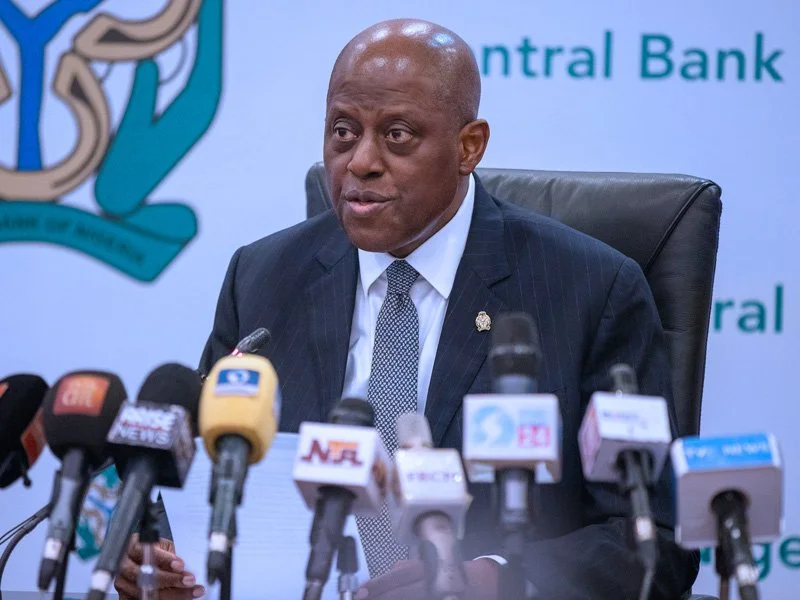
CBN Governor Olayemi Cardoso
Members of the Central Bank of Nigeria’s (CBN) Monetary Policy Committee (MPC) have warned that Nigeria’s 23% benchmark interest rate will not, on its own, deliver sustainable economic growth, calling for complementary fiscal reforms, stronger domestic production and improvements in infrastructure.
/ You Might Also Like /




The concerns followed the committee’s September 2026 decision to reset the Monetary Policy Rate (MPR) from 26.5% to 23%. In their individual statements, MPC members Bandele Amoo, Murtala Sabo Sagagi and Aku Pauline Odinkemelu highlighted structural weaknesses, food insecurity, inadequate infrastructure and fiscal pressures as major obstacles to reducing inflation and reviving economic activity.
MPC Members Highlight Limits of Interest Rate Policy
Bandele Amoo said his primary concern was the limited response of productive sectors to improvements in macroeconomic conditions. He argued that monetary policy alone could not resolve the supply-side problems driving food prices and constraining economic activity.
He identified insecurity, poor transport and logistics networks, inadequate storage facilities and limited irrigation coverage as barriers to agricultural productivity. These constraints can reduce the supply of food, increase distribution costs and sustain inflation even when monetary conditions become less restrictive.
Amoo also called for closer coordination between fiscal and monetary authorities, pointing to the memorandum of understanding between the CBN and the Federal Ministry of Finance as a step towards improving policy consistency.
However, he stressed that coordination must preserve the independence of monetary policy decisions, which should remain guided by economic evidence and medium-term price stability objectives.
Murtala Sabo Sagagi similarly argued that Nigeria's weak productive capacity limits the ability of monetary policy to stimulate growth. He identified infrastructure deficiencies, insecurity in farming and mining communities, governance challenges and rising public debt as constraints requiring broader government action.
Sagagi called for complementary fiscal, structural and governance reforms to improve public-sector accountability and create conditions for stronger economic expansion.
Inflation Eases but Food Security Remains a Concern
Nigeria’s headline inflation rate declined to 14.63% year-on-year in September 2026, down from 15.39% in August and 20.98% in September 2025, according to the National Bureau of Statistics.
Despite this improvement, MPC member Aku Pauline Odinkemelu warned that lower inflation figures did not fully reflect the financial pressures facing households.
She cited an International Monetary Fund projection that 34.7 million Nigerians could face acute food insecurity during the 2026 lean season, highlighting the continuing relationship between food availability, household purchasing power and economic stability.
Odinkemelu argued that strengthening the transmission of monetary policy and sustaining the decline in inflation would remain important for protecting household incomes. She also emphasised fiscal discipline and closer coordination between monetary and fiscal authorities as essential conditions for a credible transition towards an inflation-targeting framework.
The members' statements highlight a key challenge for policymakers: reducing inflation sustainably requires more than adjusting interest rates when inadequate production, distribution difficulties and insecurity continue to push up costs.
What the 23% Interest Rate Means for Businesses
The CBN's decision to reset the benchmark interest rate to 23% marked a 350-basis-point reduction from the previous 26.5% level. The adjustment aimed to improve the transmission of monetary policy through the financial system and align the benchmark more closely with prevailing money-market conditions.
However, the reset does not automatically translate into cheaper loans for businesses and households. Commercial banks consider several factors when setting lending rates, including their funding costs, credit risks, liquidity conditions and operating expenses.
Businesses seeking finance may therefore continue to face high borrowing costs even after the benchmark rate adjustment. This could constrain investment, expansion and working capital, particularly for companies operating in capital-intensive sectors.
The MPC members' warnings suggest that the impact of monetary policy will depend partly on whether government reforms improve the conditions under which businesses produce goods, move products and access essential infrastructure.
Implications for Nigeria's Housing and Real Estate Sector
The debate has important implications for Nigeria's housing market, where developers depend on access to finance, stable construction costs and effective infrastructure to deliver projects.
High borrowing costs can make property development more expensive by increasing the cost of construction loans and limiting the number of projects developers can finance. They can also restrict mortgage access for households, reducing the pool of buyers able to purchase completed homes.
Even if the 23% benchmark eventually supports lower lending rates, structural challenges may continue to limit housing delivery. Poor transport infrastructure, unreliable power supply, insecurity and expensive building-material logistics can raise development costs independently of monetary policy.
The MPC members' emphasis on productive capacity and infrastructure therefore reinforces the need for coordinated economic reforms that extend beyond interest rate adjustments.
For housing developers, investors and prospective homeowners, improvements in financing conditions will need to coincide with measures that reduce construction costs, strengthen supply chains and expand access to serviced land and infrastructure.
Fiscal Coordination and Structural Reforms Remain Critical
The MPC members called for greater consistency between monetary policy and government spending, warning that fiscal pressures could undermine efforts to stabilise prices.
Fiscal discipline matters because excessive government borrowing and poorly coordinated spending can complicate inflation management and affect the availability of credit to private businesses.
At the same time, targeted investments in transport, agricultural infrastructure, irrigation and storage can improve productive capacity, ease supply constraints and support more durable price stability.
The challenge for policymakers is to maintain credible inflation control while creating conditions for stronger investment, job creation and output growth.
Outlook
The MPC members' assessment underscores the limits of relying on interest rate adjustments alone to revive Nigeria's economy. Although inflation has moderated and the benchmark rate now stands at 23%, persistent supply-side constraints continue to threaten price stability and productive activity.
Sustained economic recovery will depend on whether monetary discipline is accompanied by fiscal responsibility, infrastructure investment, improved agricultural productivity and stronger governance.
For Nigeria's housing market and wider business environment, the effectiveness of these complementary reforms will help determine whether improved macroeconomic conditions translate into lower financing costs, greater investment and increased economic activity.
READ MORE