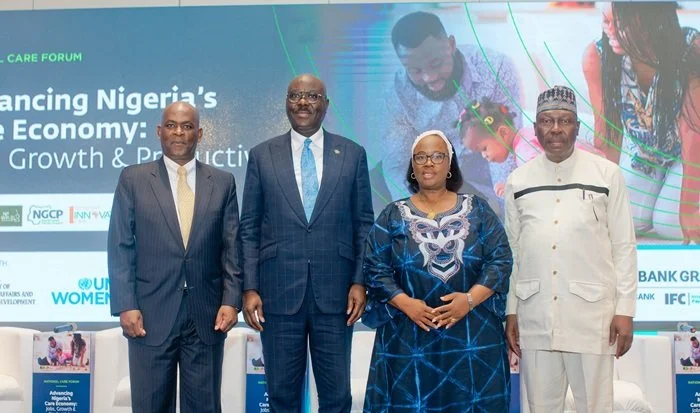
Government officials, development partners and private-sector stakeholders are pushing for greater investment in childcare and other care services
Nigeria’s care economy could generate between 9.4 million and 17 million jobs and contribute at least $9.3 billion to the country’s Gross Domestic Product (GDP), according to projections presented at the National Care Forum in Lagos on November 17, 2026.
The projections, drawn from UN Women’s 2026 care economy modelling for West and Central Africa, have renewed calls for investment in childcare, elderly care, disability support and other essential services. Stakeholders at the forum urged the Federal Government, state governments, financial institutions and private businesses to improve access to funding and establish stronger coordination to develop the sector.
/ You Might Also Like /




The discussions followed the Federal Executive Council’s approval of the National Care Policy and Implementation Plan 2026–2030 on October 28, 2026. The policy aims to organise care services, improve working conditions for caregivers and expand access to services that support families and economic participation.
Childcare Gaps Limit Women’s Economic Participation
Presenting a World Bank Group report on the economic case for childcare in Nigeria, Senior Economist at the organisation’s Gender Innovation Lab, Ayodele Fashogbon, highlighted the unequal distribution of childcare responsibilities between women and men.
He said Nigerian women spend an average of 76 minutes daily on childcare, compared with 13 minutes for men. He also noted that approximately 33 million children aged zero to five lack access to centre-based childcare.
The report indicated that women’s employment declines by about 36% following the arrival of a child below six years, while men’s employment increases by approximately 10%.
Fashogbon said expanding access to quality childcare could increase women’s employment by 8.5%, raise their income by 22.5% and improve household income by about 44%.
He also estimated that closing the gender labour-force participation gap could contribute as much as $22.9 billion to Nigeria’s annual GDP. This is a separate projection from the $9.3 billion contribution associated with expanding the wider care economy and should not be treated as the same estimate.
National Care Policy Seeks to Build an Investable Sector
Representing the Minister of Women Affairs and Social Development, Imaan Sulaiman-Ibrahim, Director of Child Development, Andrew Ali Madugu, said the National Care Policy provides a framework for expanding care services and improving the conditions of workers in the sector.
The policy covers childcare, early childhood development, elderly care, disability support, care workers’ welfare and family-friendly workplaces. It also provides for sustainable financing, including a proposed National Care Fund.
Madugu said the Federal Executive Council had approved three national instruments on October 28, including the National Care Policy and Implementation Plan 2026–2030, the National Programme on Violence Against Children and the National Policy on Mental Health and Ageing Management 2026–2030.
He urged state governments to adopt the policy and called for investment in professional training, decent wages and improved working conditions for care workers.
The policy's approval establishes a national framework, but the projected employment and GDP gains will depend on implementation, funding and the expansion of services across the country.
Limited Access to Finance Restrains Childcare Businesses
Stakeholders identified funding constraints as a major obstacle to expanding childcare services and developing care-related businesses.
Fashogbon said approximately 75% of childcare providers struggled to secure funding, while only 5% of private-sector employers invested in childcare.
Christian Mulamula, Head of Office at the International Finance Corporation (IFC) in Nigeria, also highlighted the financing challenges facing operators. He said about 92% of childcare facilities were small, independently owned businesses, while 76% of childcare entrepreneurs lacked access to formal finance.
These constraints limit the ability of operators to establish new facilities, improve service quality, train workers and expand into underserved communities.
Mulamula called for financial institutions and investors to develop financing models suited to childcare businesses, noting that the sector requires investment in facilities, technology, professional training and service delivery.
More than 4,500 aspiring caregivers and entrepreneurs, approximately 90% of them women, were undergoing training under the World Bank-supported Innovation, Development and Effectiveness in Acquisition of Skills (IDEAS) project, he disclosed.
Lagos Develops Framework to Attract Private Investment
Lagos State is developing an investment-focused care policy framework aimed at encouraging private-sector participation and improving access to childcare services.
Representing Governor Babajide Sanwo-Olu, Commissioner for Finance Abayomi Oluyomi said the state intends to establish appropriate regulations and safety standards while working with financial institutions to develop financing models for childcare businesses.
He urged employers to consider childcare investment as part of efforts to improve staff retention and productivity.
The state's approach reflects growing recognition that childcare and other care services require infrastructure, funding and professional standards rather than relying primarily on unpaid household labour.
Investment and Implementation Will Determine Economic Gains
Nigeria's projected care economy growth presents opportunities for childcare operators, training institutions, financial service providers and investors in facilities that support elderly people and persons with disabilities.
However, translating the projections into jobs and economic output will require more than policy approval. The government will need to establish clear financing arrangements, improve access to affordable capital, enforce quality and safety standards, and ensure that care services remain accessible to lower-income households.
The proposed National Care Fund could provide a financing mechanism, but its eventual structure, funding sources and implementation arrangements will determine its effectiveness.
For investors, the sector offers potential for new businesses and service infrastructure. For policymakers, the challenge is to build a commercially sustainable care market without making essential services unaffordable to the families that need them.
READ MORE