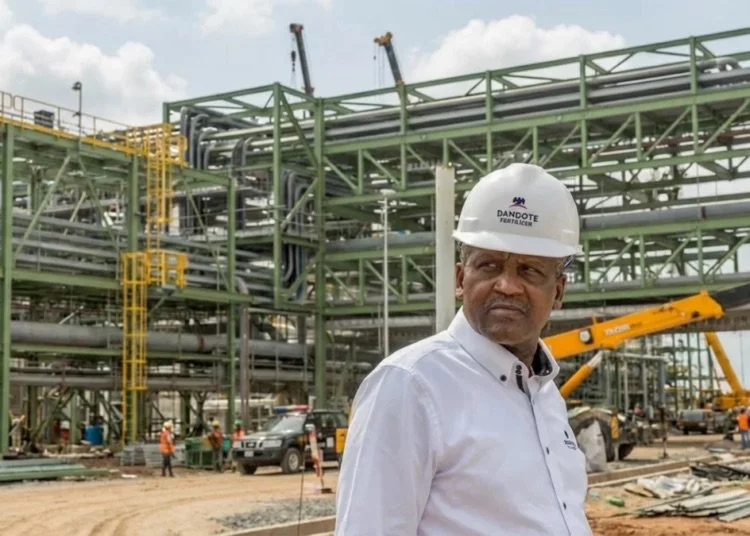
Nigeria’s Crude Supply Gap Leaves Dangote Refinery Short of 700,000 Barrels a Day

Nigeria’s crude supply constraints limit allocations to the Dangote Petroleum Refinery
Nigeria’s Federal Government has acknowledged that the country cannot yet supply the Dangote Petroleum Refinery with its full daily crude oil requirement of 700,000 barrels, despite efforts to increase production and reduce oil theft. Finance Minister and Coordinating Minister of the Economy, Taiwo Oyedele, disclosed the constraint during an interview on Channels Television’s Politics Today, explaining that production-sharing contracts, joint ventures, royalties, production costs and existing commitments limit the volume of crude available for government allocation.
/ You Might Also Like /




The disclosure highlights a structural challenge facing Nigeria’s domestic refining ambitions: the country’s total crude oil production does not represent the volume it can freely allocate to local refineries. Although production has improved, the government says it has yet to secure sufficient uncommitted crude to meet the refinery’s full requirements.
The issue has renewed debate over crude allocation, domestic refining, petroleum pricing and the government’s role in supporting local processors.
Production Does Not Translate Directly Into Available Crude
Oyedele said Nigeria produces approximately 1.8 million barrels of crude oil per day, but a substantial portion of that output goes towards contractual obligations involving oil-producing companies and the government.
Under production-sharing contracts and joint ventures, companies and the state share production according to agreed terms. Producers also recover eligible production costs, while royalties and other contractual obligations determine how much crude ultimately accrues to the government.
These arrangements reduce the quantity of oil available for discretionary allocation, including supplies to domestic refineries.
The minister explained that Nigeria’s available crude had been further constrained by commitments tied to previous government financing and fuel consumption obligations.
According to Oyedele, the Nigerian National Petroleum Company Limited (NNPCL), which manages the country's crude oil interests on its behalf, had less than 100,000 barrels of freely available crude remaining before the economic reforms introduced in May 2023.
He said the government had relied on future oil production to support present consumption, leaving a substantial portion of its crude tied to existing commitments.
Although the government has since increased production, intensified efforts against oil theft and renegotiated some commitments, Oyedele said the country still cannot meet the refinery’s entire daily requirement from available domestic supplies.
Dangote Refinery Continues to Import Crude
The supply constraint means the Dangote Petroleum Refinery cannot depend entirely on government-allocated Nigerian crude to meet its processing needs.
Oyedele confirmed that the refinery imports crude oil to supplement domestic supplies. He also rejected proposals for the government to provide crude at discounted prices or at production cost, arguing that such measures would overlook the limited volume available for allocation.
The minister said the naira-for-crude arrangement had helped provide some stability but had not eliminated the underlying supply challenge.
The distinction is important because the availability of domestic crude is a separate issue from the refinery’s installed processing capacity. A refinery may have the equipment and operational capability to process large volumes, but it still requires reliable access to sufficient feedstock.
For the Dangote refinery, securing that supply is central to maintaining operations at its intended capacity. Where domestic allocations fall short, imported crude becomes an alternative, exposing the refinery to international sourcing costs and associated logistics.
Government Rules Out Discounted Crude Supply
The government’s position comes amid renewed calls for intervention in the petroleum market, including proposals for discounted crude, production support and measures intended to reduce the cost of refined petroleum products.
Oyedele argued that supplying crude at a discount would not resolve the underlying availability problem. Nigeria must first generate sufficient uncommitted production before it can increase allocations to Dangote and other domestic refiners.
His position also reflects the government's broader stance against returning to the former petrol subsidy regime.
The minister has maintained that policies which commit public revenue or crude oil to subsidised consumption can weaken government finances and limit resources available for other priorities.
The latest disclosure therefore places crude availability at the centre of the debate over domestic refining. Increasing refinery capacity alone will not guarantee energy security if crude production, contractual arrangements and allocation mechanisms cannot provide sufficient feedstock.
Oil Theft and Existing Commitments Remain Key Constraints
Nigeria has taken steps to improve crude production and reduce losses associated with oil theft. Oyedele acknowledged progress in these areas, as well as efforts to renegotiate some existing commitments that restricted the government's access to crude.
However, the available supply remains below the level required to meet Dangote's full daily demand.
The government expects further production increases and the release of additional barrels from existing commitments to improve the position. Oyedele said these developments could eventually allow Nigeria to supply Dangote and other domestic refineries with sufficient crude.
Achieving that outcome will require sustained improvements in production, effective management of contractual obligations and a clearer balance between export commitments, government revenue requirements and domestic processing needs.
The pace of progress will determine how quickly domestic refineries can obtain greater volumes of Nigerian crude without relying as heavily on imports.
Implications for Energy Security and Industrial Investment
Nigeria's inability to meet the Dangote refinery's full crude requirement illustrates the difference between expanding domestic processing capacity and establishing a dependable domestic energy supply chain.
Reliable feedstock is essential for refinery utilisation, production planning and cost management. When local supplies fall short, refiners must seek alternatives, potentially increasing exposure to international crude prices, freight costs and foreign-exchange requirements.
The constraint also has implications for Nigeria's wider industrial ambitions. Domestic refining is intended to increase local value addition, reduce reliance on imported petroleum products and strengthen the country's position in regional energy markets.
However, these benefits depend partly on the availability of crude, the commercial terms under which it is supplied and the ability of refiners to operate consistently.
The government’s challenge is to increase production and free up additional volumes without disregarding existing contractual obligations or undermining the commercial arrangements that support investment in the oil sector.
For investors, the issue reinforces the importance of evaluating feedstock security alongside installed capacity when assessing the prospects of large-scale energy infrastructure.
Outlook
The Federal Government expects higher crude production and the release of additional volumes from existing commitments to improve supplies to domestic refineries. However, it has not yet reached the point where it can meet Dangote's full daily requirement of 700,000 barrels.
The next phase of Nigeria's refining strategy will therefore depend not only on increasing production, but also on how much crude becomes available after contractual obligations, royalties, costs and other commitments have been met.
Until that gap narrows, domestic refining capacity and domestic crude availability will remain two distinct measures of progress towards Nigeria's energy security ambitions.
READ MORE