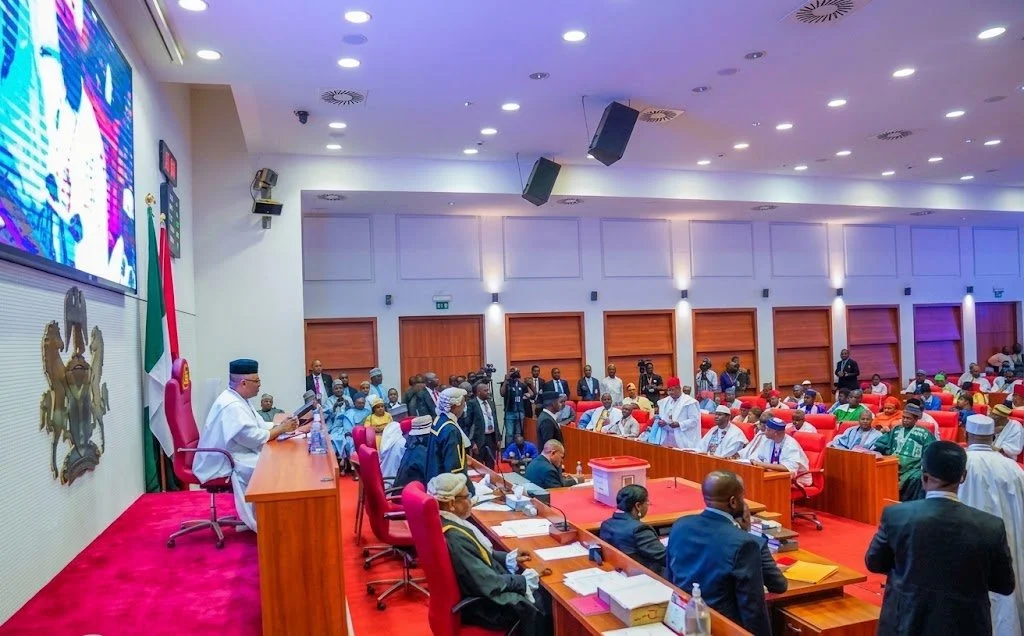
Minister of State for Industry, Trade and Investment, John Enoh, has called for stronger project management standards to reduce abandoned projects
The Federal Government has called for stronger project management standards, professional accountability and improved implementation systems to address Nigeria's persistent problem of abandoned and poorly executed projects, estimated to have cost the country more than ₦17 trillion.
The Minister of State for Industry, Trade and Investment, Senator John Enoh, said weak project planning and implementation continued to undermine infrastructure development, industrial growth and economic progress.
/ You Might Also Like /




Enoh made the call at the eighth induction and conference ceremony of the Chartered Institute of Project Managers of Nigeria (CIPMN), held in Abuja on November 3, 2026.
Represented by the ministry's Permanent Secretary, Dr Chris Isokpunwu, the minister said Nigeria's development challenge was not necessarily a shortage of policies and development plans, but the difficulty of translating them into completed projects and measurable economic outcomes.
He cited an estimate by CIPMN that the value of abandoned projects nationwide exceeded ₦17 trillion. He also referred to concerns raised by the House of Representatives over abandoned Federal Government projects and properties estimated at more than ₦20 trillion.
The minister clarified that the figures came from different assessments and periods, but both highlighted the scale of resources tied up in incomplete projects.
Poor Project Execution Undermines Infrastructure Development
Enoh said abandoned projects represented more than financial losses because they deprived communities of essential infrastructure and public services.
He pointed to incomplete hospitals, schools, roads and power projects as examples of investments that failed to deliver their intended economic and social benefits.
He also recalled a 2011 assessment by the Presidential Projects Assessment Committee, which identified 11,886 ongoing Federal Government capital projects with estimated financial commitments of ₦7.78 trillion.
According to the minister, the persistence of project delays, cost overruns and abandonment demonstrates the need for stronger planning, supervision and accountability throughout the project delivery process.
He said effective project execution would be essential to the Federal Government's ambition of building a $1 trillion economy by 2030.
The ministry has also adopted a 90-day implementation reporting cycle to monitor programme delivery and strengthen accountability.
FG Wants Licensed Professionals to Manage Projects
The Federal Government urged CIPMN to strengthen professional training, certification and enforcement to ensure that qualified practitioners oversee projects across the public and private sectors.
Enoh called on the institute to work with ministries, departments and agencies (MDAs) to establish project management structures that improve transparency, coordination and quality assurance.
The government also expects the institute to promote professional standards, strengthen technical capacity and ensure that project managers possess the skills required to manage complex development programmes.
At the institute's conference, the government further emphasised the need for project management offices within public institutions to improve monitoring and ensure that approved projects meet their timelines, budgets and quality requirements.
These measures are intended to address weaknesses that often emerge between project approval, funding, implementation and completion.
CIPMN Identifies Planning and Coordination Gaps
The Registrar-General and Chief Executive Officer of CIPMN, Henry Mbadiwe, said Nigeria's project failures were partly caused by inadequate planning, coordination and risk management rather than a shortage of technical professionals.
He argued that project management extended beyond construction, engineering and architecture, noting that nearly every sector of the economy required professionals capable of coordinating projects and ensuring successful delivery.
Mbadiwe disclosed that the institute had developed a standardised project management curriculum for Nigerian universities, which had received approval from the National Universities Commission for undergraduate programmes.
He also said CIPMN had completed a 17-module licensing framework designed to equip practitioners with the competencies required for professional project management.
The institute has digitised its membership, training, examination and licensing processes to improve access and operational efficiency. It currently has more than 2,000 members nationwide, according to Mbadiwe.
The Registrar of the Chartered Institute of Information and Strategy Management, Adelanke Oyintoke, also called for stronger collaboration between professional institutions to develop competent and ethical practitioners capable of translating development plans into completed projects.
What Stronger Project Management Means for Nigeria's Housing Sector
The call for improved project execution has direct implications for Nigeria's housing and real estate sector, where delays, cost overruns and incomplete developments can tie down significant amounts of capital.
Poor project planning can increase construction costs, delay housing delivery and weaken investor confidence. For developers, inadequate risk assessment, weak coordination and ineffective supervision can disrupt construction schedules and reduce project profitability.
The consequences extend to public housing programmes and infrastructure projects. Delays in delivering roads, drainage systems, electricity and water supply can affect the viability of housing developments, particularly in emerging urban areas.
Stronger project management systems could improve the monitoring of government housing projects, support better procurement decisions and ensure that public investments deliver completed homes and supporting infrastructure.
However, professional certification alone will not eliminate project abandonment. Effective delivery also requires reliable funding, transparent procurement, realistic cost estimates, consistent policy direction and consequences for contractors and officials responsible for poor performance.
For Nigeria's housing market, the central issue is ensuring that approved investments translate into completed developments, functional infrastructure and homes that reach their intended beneficiaries.
READ MORE