Dangote Refinery Gets Only 5 Crude Cargoes Under Naira Deal, Far Below Target
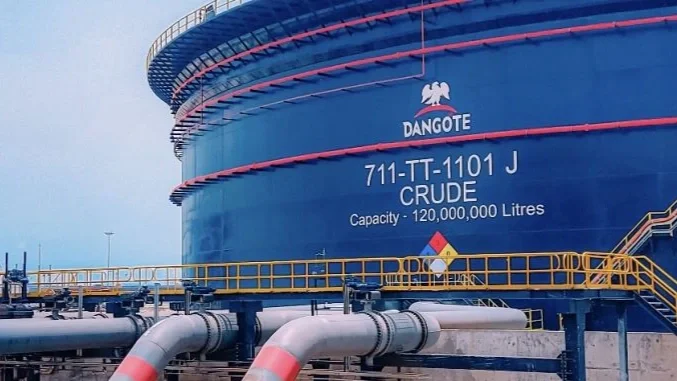
Crude Shortfall Threatens Dangote Refinery Output Despite Naira Deal
Nigeria’s Dangote Refinery is currently receiving just five crude oil cargoes per month under the Federal Government’s naira-for-crude arrangement, significantly below the expected volume of up to 15 cargoes. The shortfall underscores persistent supply challenges in Nigeria’s oil sector despite policy efforts to prioritise domestic refining.
Supply Gap Undermines Policy Objectives
The naira-for-crude policy, introduced to allow local refineries purchase crude in local currency, was designed to ensure steady feedstock supply while easing foreign exchange pressures. However, the current allocation falls far short of operational requirements.
Industry disclosures indicate that the refinery needs at least 13–15 cargoes monthly to meet domestic demand and operate efficiently, but is receiving only about five cargoes from the Nigerian National Petroleum Company Limited.
/ You Might Also Like /




Continued Reliance on International Markets
The supply deficit has forced the refinery to source crude from international markets, often at higher costs. This development weakens the intended benefits of the naira-based arrangement, which was expected to reduce reliance on dollar-denominated crude purchases.
Despite being Africa’s largest oil producer, Nigeria continues to face a structural disconnect between crude production and domestic refining needs. In 2025 alone, refineries imported crude worth over ₦5.7 trillion due to local supply constraints.
Structural Challenges in Domestic Supply
Several factors contribute to the ongoing shortfall:
International oil companies prioritising exports due to better pricing
Contractual obligations tied to foreign markets
Pricing disputes within the domestic supply framework
Weak enforcement of domestic crude supply obligations
These issues have limited the effectiveness of policies aimed at boosting local refining capacity.
Pricing Reality Limits Policy Impact
Even under the naira-for-crude framework, crude oil supplied to the refinery is priced at international benchmark rates. This means the refinery remains exposed to global oil price volatility, limiting the potential for lower domestic fuel prices.
Implications for Nigeria’s Energy Sector
The crude supply gap highlights a critical bottleneck in Nigeria’s energy value chain. While the Dangote Refinery has the capacity to significantly reduce fuel imports and stabilise supply, inadequate feedstock threatens its ability to operate at full scale.
For policymakers, the development raises concerns about the implementation of the Petroleum Industry Act’s domestic supply provisions and the broader effectiveness of energy sector reforms.
Outlook
The mismatch between crude supply and refinery demand remains a key risk to Nigeria’s goal of achieving energy self-sufficiency.
Resolving the shortfall will require stronger enforcement of domestic supply obligations, improved pricing frameworks, and closer coordination between upstream producers and local refiners. Without these adjustments, the benefits of the naira-for-crude policy may remain limited, and reliance on imported crude could persist.
READ MORE