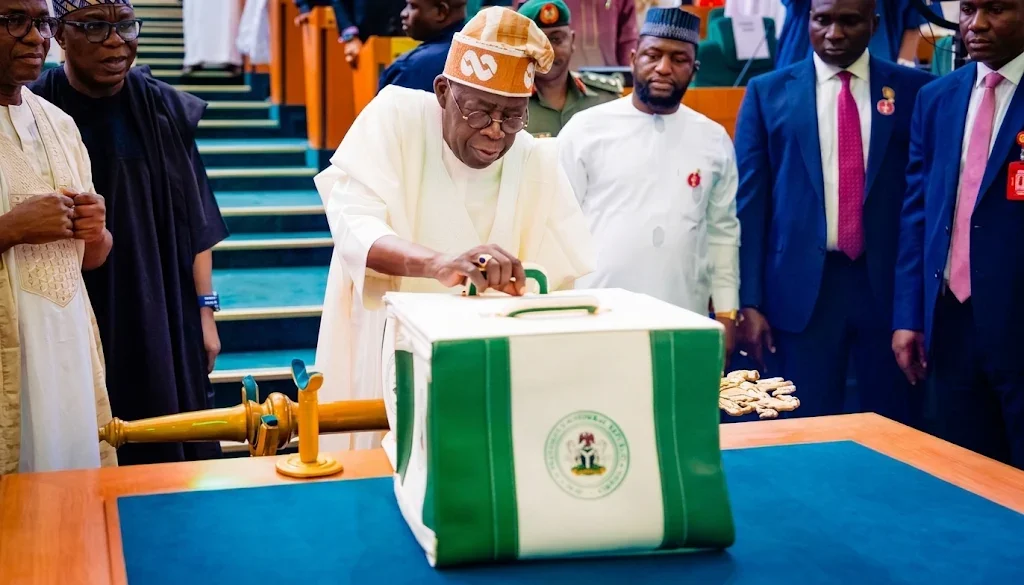
CBN Governor Olayemi Cardoso addresses foreign exchange market pressures.
Central Bank of Nigeria (CBN) Governor Olayemi Cardoso has attributed recent pressure on the naira to seasonal foreign exchange demand, portfolio investors adjusting their positions and increased spending ahead of the 2027 general elections.
Cardoso gave the explanation on Tuesday, November 24, 2026, during a media briefing in Abuja following the 308th meeting of the Monetary Policy Committee (MPC). He also sought to reassure Nigerians that the country's foreign exchange reserves remained strong enough to withstand external shocks despite a recent decline.
/ You Might Also Like /




The CBN governor said Nigeria's gross external reserves stood between $54 billion and $55 billion, providing approximately 10 months of import cover. He described the recent movement in reserves and the exchange rate as temporary market adjustments rather than signs of a deterioration in the country's external position.
His comments came amid renewed pressure on the naira, which weakened to ₦1,394 per dollar at the official market on November 20, its weakest closing level in eight months.
Seasonal demand and investor adjustments pressure the naira
Cardoso identified year-end portfolio adjustments as one of the factors contributing to increased demand for foreign exchange.
Foreign portfolio investors typically reassess or adjust their positions towards the end of the year, potentially increasing demand for dollars as they reposition their investments.
He also pointed to domestic businesses seeking to hedge against possible exchange-rate movements ahead of the new year. Such activity can increase demand for foreign currency as companies seek to protect themselves against potential changes in the naira's value.
The governor further identified increased spending associated with the forthcoming 2027 general elections as another source of demand pressure.
He said the CBN expected the current volatility to moderate significantly as Nigeria moves into 2027.
The explanation comes as the foreign exchange market experiences higher trading activity without a corresponding strengthening of the naira.
CBN says $54bn reserves provide 10 months of import cover
Cardoso maintained that Nigeria's external reserves remained substantial despite the recent decline.
He put the reserves at between $54 billion and $55 billion, which he said provided approximately 10 months of import cover. The reserves serve as an important buffer for meeting external obligations and supporting foreign exchange market stability.
Data cited in the Nairametrics report showed that gross external reserves declined by $390.94 million over 16 calendar days to $54.87 billion as of November 12, 2026.
The decline followed a slower increase in reserves during October, when gross reserves rose by $295.35 million, the smallest positive monthly increase recorded so far in 2026.
Cardoso acknowledged the decline but maintained that the country's external position remained strong. He also pointed to favourable current account balances and diaspora remittance inflows as supporting factors.
He disclosed that diaspora remittances approached $1.9 billion in the preceding month, describing the inflows as an important source of foreign exchange support.
Naira weakens despite increased foreign exchange trading
The governor's comments come against a backdrop of increased activity in Nigeria's foreign exchange market, where higher transaction volumes have not prevented the naira from losing value.
Foreign exchange turnover rose by 36.59 per cent week-on-week to $4.67 billion in the week ended November 20, compared with $3.42 billion in the preceding week, according to FMDQ data reviewed by Nairametrics.
Despite the increase in turnover, the naira depreciated by 2.50 per cent during the week to close at ₦1,394 per dollar, its weakest closing level in eight months.
Spot transactions accounted for $4.64 billion, representing 99.40 per cent of total turnover, while forward transactions declined by 83.88 per cent to $28.19 million.
The figures indicate that increased trading activity has not necessarily translated into sufficient dollar supply to stabilise the currency. Higher turnover can reflect stronger demand as well as increased supply, making the composition of transactions important when assessing market liquidity.
The pressure also persisted despite the CBN's reported sale of $1.30 billion to meet foreign exchange demand during the week. Analysts at Cordros Securities said demand from foreign portfolio investors outweighed the central bank's intervention.
Diaspora remittances support external reserves
Cardoso also highlighted diaspora remittances as an important source of foreign exchange inflows supporting Nigeria's external position.
He disclosed that remittances approached $1.9 billion in October, providing additional support for the country's foreign exchange buffers.
Remittance inflows remain an important source of foreign currency for Nigeria, alongside export earnings and foreign investment. Their contribution can help improve dollar availability and support the balance of payments.
The governor also pointed to favourable current account balances as evidence of underlying support for the country's external position.
However, the recent depreciation of the naira suggests that these inflows have not completely offset demand pressures from businesses, investors and other market participants.
CBN retains interest rate at 23 per cent
Cardoso's comments followed the MPC's decision to retain the Monetary Policy Rate (MPR) at 23 per cent at its 308th meeting held on November 23 and 24, 2026.
The committee also retained the Standing Facilities Corridor at +50/-300 basis points around the MPR.
Other monetary policy parameters remained unchanged:
Cash Reserve Requirement for deposit money banks: 45 per cent.
Cash Reserve Requirement for merchant banks: 16 per cent.
Cash Reserve Requirement on non-Treasury Single Account public sector deposits: 75 per cent.
The committee said it considered the moderation in headline inflation over five consecutive months, alongside the risks that could slow further improvements in price stability.
Maintaining the existing policy rate reflects the CBN's decision to sustain its current monetary policy stance while monitoring domestic and international economic developments.
What continued naira pressure means for property and construction
Exchange-rate movements remain important to Nigeria's property and construction markets because developers depend on imported materials, equipment and building components.
Products such as specialised fittings, electrical equipment, lifts, finishing materials and some construction machinery expose developers to foreign exchange costs. When the naira weakens, the local currency cost of importing these items can increase, potentially raising project budgets and putting pressure on property prices.
Developers with outstanding foreign currency obligations may also face higher repayment costs when the naira depreciates. Contractors and investors that rely on imported inputs could experience additional uncertainty when preparing project estimates and financing arrangements.
However, the effect on construction costs will depend on the extent of imported input exposure, existing inventories, supplier pricing and the ability of developers to absorb or pass on higher costs.
For property investors, the direction of the exchange rate also matters when assessing investment returns, particularly for those converting rental income or property-sale proceeds into foreign currency.
The CBN's assessment that current pressures could moderate as Nigeria moves into 2027 will therefore remain important to businesses monitoring foreign exchange availability and the cost of imported inputs.
Conclusion
Cardoso's explanation highlights the combination of seasonal demand, portfolio investor adjustments and election-related spending behind recent pressure on the naira. Although the CBN maintains that Nigeria's foreign exchange reserves remain sufficient, the currency's recent depreciation and increased market activity show that demand and supply conditions continue to influence exchange-rate stability.
The extent to which the pressure eases will depend on foreign exchange inflows, market demand, investor confidence and the CBN's ability to maintain stability without placing excessive pressure on external reserves.
READ MORE