Benin-Asaba Road Dispute Raises Fresh Questions Over Nigeria’s PPP Model
Benin-Asaba Expressway
The dispute surrounding the Benin-Asaba Expressway is increasingly becoming a test of Nigeria’s ability to manage long-term public-private partnerships (PPPs) for critical infrastructure, with questions emerging over contractual obligations, government intervention and investor confidence.
The controversy follows concerns over the condition of sections of the highway and disagreements between the Federal Government and the Benin-Asaba Expressway Concession Company (BAECC), the private concessionaire responsible for the project.
/ You Might Also Like /




While the immediate concern remains restoring the road and reducing the hardship faced by motorists, the dispute has broader implications for Nigeria’s infrastructure investment framework.
The Benin-Asaba concession was structured as a 25-year Design, Finance, Build, Operate and Transfer arrangement, placing long-term responsibilities on the private concessionaire rather than treating the project as a conventional government-funded road contract.
Dispute Goes Beyond Road Conditions
The latest controversy centres on how the government can respond when a concessioned road develops serious problems while a private company remains contractually responsible for the asset.
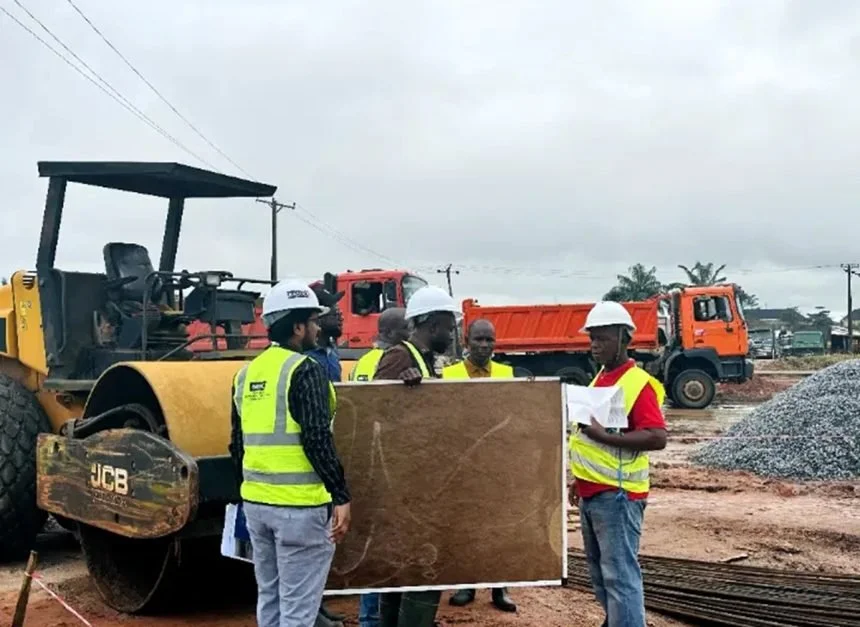
The Federal Government previously criticised BAECC over the deterioration of the highway and considered intervention to restore affected sections. In August, the government announced plans to review road concessions following the worsening condition of the corridor.
The latest debate introduces another question: what happens to the existing concession when another contractor is brought in to carry out work on part of the corridor?
If another company reconstructs sections of the highway, responsibility for construction quality, maintenance and future performance must be clearly established.
That becomes particularly important where the original concessionaire remains responsible for the road under a long-term agreement.
Why the PPP Structure Matters
A PPP differs from a conventional government-funded construction contract because the private participant assumes defined responsibilities and risks over an extended period.
In the Benin-Asaba arrangement, the concessionaire is not simply constructing the road and handing it back to government. The long-term structure gives the private sector responsibility for financing, developing, operating and maintaining the asset within the terms of the concession.
That structure is intended to provide government with access to private capital and expertise while allowing investors to recover their investment over time.
Consequently, any major government intervention needs to be considered alongside the contractual rights and obligations of the concessionaire.
Government Still Has Responsibility to Road Users
The existence of a concession does not remove government's responsibility to protect road users when infrastructure deteriorates.
The Federal Ministry of Works has already directed emergency intervention on failed sections of the Benin-Asaba corridor, with the government saying it will bear the cost of the emergency works. It has also ordered the redesign of the route for reconstruction using reinforced concrete pavement.
This creates a delicate balance.
Government must respond when road conditions create significant risks or disruption, while the contractual framework needs to determine how such intervention interacts with the concessionaire's obligations.
Concessionaire Attributes Challenges to Rainfall and Traffic
BAECC has maintained that construction challenges have been influenced by persistent rainfall and the heavy traffic volume along the corridor.
The company has also said it has undertaken substantial construction and palliative work and committed significant private resources to the project.
These explanations will ultimately need to be assessed against the project's contractual milestones, technical requirements and agreed performance obligations.
The dispute therefore involves more than competing public statements. It raises questions that can be tested against the concession agreement and the project's technical documentation.
What the Dispute Means for Infrastructure Investors
Nigeria needs substantial private capital to close its infrastructure gap.
Government revenues alone cannot finance the roads, bridges, rail infrastructure, power facilities and other public assets required to support economic growth.
PPPs are consequently expected to remain an important financing mechanism.
For private investors, however, long-term infrastructure projects require confidence that contractual arrangements will remain sufficiently predictable throughout the life of an investment.
Investors committing capital to projects lasting 20 or 25 years need clarity on how disputes will be handled, how performance will be enforced and what happens when government needs to intervene in the public interest.
The Benin-Asaba case therefore has implications beyond the road itself.
Implications for Future PPP Projects
The outcome could influence how future infrastructure concessions are structured and monitored.
Government may place greater emphasis on the technical capacity of concessionaires, construction milestones, drainage and traffic-management requirements, performance guarantees and intervention mechanisms.
Concessionaires, meanwhile, may face greater scrutiny over whether they have the financial and technical capacity to deliver projects under difficult operating conditions.
Clearer contractual mechanisms could help reduce uncertainty when emergency intervention becomes necessary.
Infrastructure Reliability Matters to Property Markets
The Benin-Asaba corridor also has implications for real estate and commercial development in Edo and Delta states.
The highway connects major urban and commercial centres and supports the movement of people, goods, agricultural produce and construction materials.
Reliable transport infrastructure can improve accessibility to emerging communities and support residential, commercial and industrial development along major corridors.
Conversely, prolonged road deterioration can increase travel times and logistics costs, potentially affecting the attractiveness and operating economics of developments along the route.
For property investors and developers, infrastructure reliability is therefore an important consideration when assessing locations outside established urban centres.
The Immediate Priority Remains the Road
Despite the wider PPP debate, motorists and businesses using the Benin-Asaba corridor remain primarily concerned about the condition of the highway.
The Federal Government has already moved towards emergency repairs, while the wider concession arrangement remains under scrutiny.
The challenge is to resolve the immediate road crisis without creating additional uncertainty around the long-term contractual framework.
A coordinated solution could allow emergency works to proceed while preserving a clear process for determining responsibility, costs and future maintenance.
Outlook
The Benin-Asaba dispute provides a broader test of how Nigeria balances public interest, contractual obligations and private investment in infrastructure.
For government, the priority is ensuring that concessioned infrastructure delivers the public service expected from it. For concessionaires, the responsibility is to meet the performance and technical requirements established under their agreements.
For investors, the credibility of the PPP framework will depend on whether disputes can be resolved through transparent contractual and institutional mechanisms.
The resolution of the Benin-Asaba case could therefore have significance well beyond the 125-kilometre corridor. It may help shape how developers, infrastructure funds, lenders and other private investors assess opportunities to participate in Nigeria's future infrastructure projects.
READ MORE