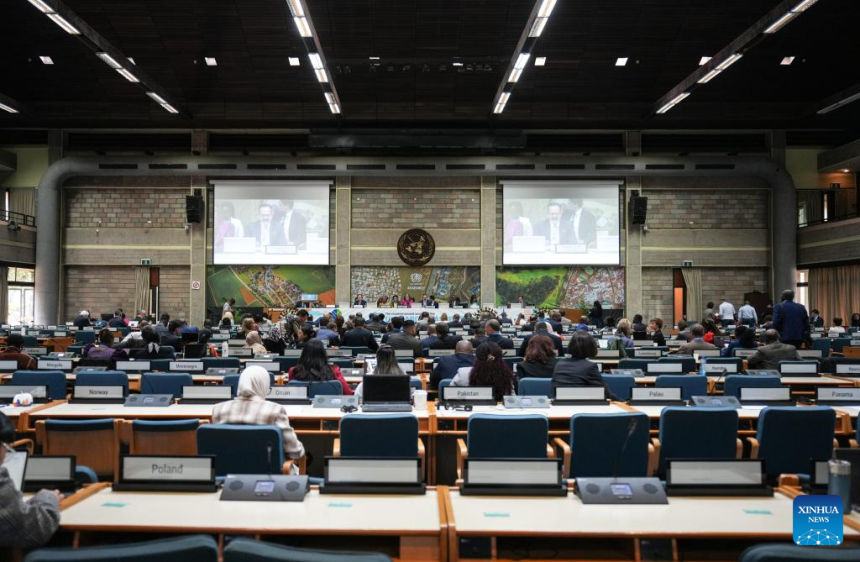
Government representatives and housing experts meet in Nairobi to discuss policies for adequate and resilient housing
Government representatives and housing experts from across the world are meeting in Nairobi, Kenya, on 26 and 27 November 2026 to develop policy recommendations for tackling homelessness, improving housing affordability and strengthening the resilience of homes and communities.
/ You Might Also Like /




The meeting, convened by the United Nations Human Settlements Programme (UN-Habitat), is the third session of the Open-ended Intergovernmental Expert Working Group on Adequate Housing for All. It brings together member states to consider how national housing policies can respond more effectively to growing demand, insecure housing, informal settlements and climate-related risks.
The discussions come as the scale of the global housing challenge continues to widen. UN-Habitat estimates that up to 3.4 billion people lack safe, secure and adequate housing, including more than 1.1 billion living in informal settlements and slums.
The working group aims to develop recommendations for consideration by the UN-Habitat Assembly in 2029, providing governments with a framework for strengthening housing policies and expanding access to adequate homes.
UN-Habitat Highlights Scale of Global Housing Crisis
UN-Habitat Executive Director Anacláudia Rossbach said the meeting provides an opportunity to bring homelessness and inadequate housing higher on the international policy agenda.
She estimated that approximately 300 million people worldwide live without a roof over their heads, while noting that the absence of a common global definition of homelessness makes it difficult for governments to measure the problem consistently and develop targeted responses.
The organisation's World Cities Report 2026 also estimates that more than 1.1 billion people live in informal settlements and slums, often without secure land tenure, safe water and adequate sanitation.
The figures highlight the difference between having shelter and having adequate housing. Housing adequacy also involves security of tenure, access to essential services, affordability, habitability and protection from environmental risks.
Discussions Focus on Homelessness, Housing Policy and Climate Resilience
The Nairobi meeting is examining three interconnected priorities: establishing a shared understanding of homelessness, improving national housing policies, and making housing more sustainable and resilient.
The proposed global definition of homelessness is intended to help governments recognise different forms of housing deprivation, including people without accommodation and those living in severely inadequate or insecure conditions.
Participants are also considering recommendations on integrated national housing policies. The approach encourages governments to connect housing programmes with land administration, infrastructure, finance, urban planning and social protection rather than treating housing as an isolated policy area.
The third priority focuses on climate resilience and the environmental impact of housing development. This includes improving the safety of homes and informal settlements exposed to flooding, extreme weather and other climate-related threats.
UN-Habitat has emphasised that housing policies must consider not only the number of homes built but also where they are located, the quality of their construction and their access to essential services.
UN-Habitat Launches Housing Knowledge Platform
The meeting also provides the platform for the launch of the first version of UN-Habitat's Housing Knowledge Platform, an online resource designed to bring together housing data, policy documents, research and examples of housing initiatives from different countries.
The platform is intended to help governments and other stakeholders access information that is currently spread across institutions and national systems.
Its initial resources include a repository of national housing policies, learning materials and examples of housing practices. The first collection draws on 171 initiatives from 84 countries presented at the World Urban Forum in Baku in May 2026.
UN-Habitat expects the platform to support knowledge-sharing and help policymakers identify approaches that can be adapted to their own housing markets and institutional conditions.
Revised versions of the working group's draft recommendations are expected to be published in January 2027 following the Nairobi discussions.
Local Governments and Communities Identified as Key to Housing Solutions
UN-Habitat has also stressed the importance of involving local authorities and communities in housing policy development.
Rossbach said local governments are often better positioned to understand the conditions facing vulnerable communities because they work closer to residents and have more direct knowledge of local housing needs.
The approach recognises that national housing policies require implementation at local levels, where land use, infrastructure, public services and settlement planning directly affect housing outcomes.
The organisation also highlighted the contributions of researchers, private-sector participants and community groups in developing practical responses to housing challenges.
Implications for Africa's Housing Policy and Investment
The Nairobi discussions carry particular significance for African countries, where rapid urbanisation, limited infrastructure and constrained access to housing finance continue to affect housing delivery.
For Nigeria, the priorities identified by UN-Habitat align with longstanding challenges in land administration, mortgage access, informal settlement upgrading, housing affordability and climate-related risks.
An integrated approach could help connect housing construction with land availability, transport infrastructure, utilities and financing mechanisms. It could also strengthen the coordination between federal, state and local governments, whose decisions influence housing supply and urban development.
However, the meeting is focused on developing recommendations rather than announcing a funded housing programme or binding commitments to construct homes. Its eventual value will depend on how governments translate the recommendations into national policies, financing arrangements and measurable delivery targets.
For housing investors, developers and policymakers, the discussions reinforce the need to view housing as part of a wider urban and economic system, with affordability, infrastructure, environmental resilience and secure tenure all influencing the long-term sustainability of property markets.
READ MORE