Katsina Launches Household Survey Report to Strengthen Evidence-Based Policy
Katsina Launches Data-Driven Household Survey for Better Policy Decisions
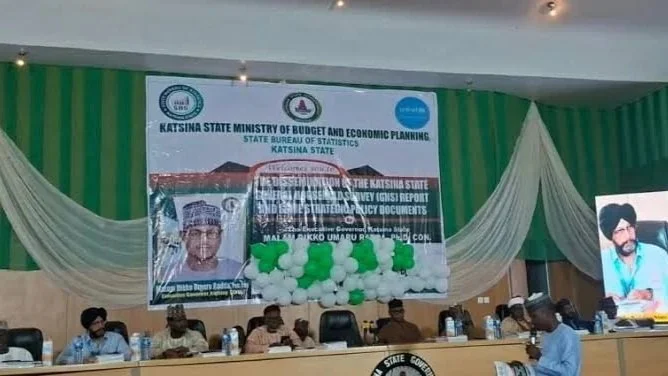
Katsina State Government has launched its General Household Survey (GHS) Report to strengthen evidence-based planning and improve the targeting of development programmes across the state’s 34 local government areas.
/ You Might Also Like /




Governor Dikko Radda, represented by his Deputy, Alhaji Faruq Jobe, said the report provides household-level data covering welfare, poverty, employment, livelihoods, agriculture, education, health, housing, water, sanitation, access to basic services and social protection.
Survey to Guide Government Planning
According to the state government, the household survey is intended to help policymakers move away from assumptions and use reliable data when designing development interventions.
Radda said the findings would enable government to identify areas with the greatest needs, allocate resources more effectively and measure the performance of interventions against established indicators.
He also directed Ministries, Departments and Agencies (MDAs) to use statistical evidence when preparing policies, strategic plans, annual budgets and monitoring frameworks.
Housing and Basic Services Included
The survey covers several areas with direct implications for housing and urban development.
Its findings include information on housing conditions, access to water and sanitation, household welfare and access to basic services. Such data can help government identify communities facing deficits in essential infrastructure and determine where public investment is most needed.
For the housing sector, reliable household-level information can also support better understanding of housing needs, affordability pressures and the distribution of vulnerable households across the state.
Report to Help Target Development Interventions
Katsina Commissioner for Budget and Economic Planning, Malam Malik Anas, said the survey provides a clearer picture of the socio-economic conditions of households across the state.
He said the findings would help government determine who is poor, where vulnerable households are located and the factors limiting their ability to improve their livelihoods.
The commissioner added that the report would provide a baseline for measuring progress under the state's development agenda and help direct scarce public resources towards areas where they could have the greatest impact.
UNICEF Supports Data and Planning Efforts
The UNICEF Kano Field Office provided technical and financial support for the survey and related efforts to strengthen Katsina's planning and statistical systems.
Dr Karanveer Singh, Officer-in-Charge of the UNICEF Kano Field Office, said the report provides timely evidence on the living conditions, needs and priorities of households in the state.
He stressed the importance of moving beyond the publication of the findings to translating the data into practical interventions and measurable outcomes for communities.
Implications for Housing and Investment
The availability of detailed household data could strengthen planning for housing, infrastructure and social services in Katsina.
For policymakers, accurate information on household conditions can improve decisions on where to prioritise housing schemes, water infrastructure, sanitation facilities and other essential services.
The data could also provide useful information for development partners and private investors seeking to understand demographic and socio-economic conditions across different parts of the state.
Governor Radda said reliable statistics could enhance transparency and accountability while providing investors with credible information about market opportunities and development prospects.
Focus Shifts Towards Data Driven Development
The launch reflects a broader emphasis on using statistical evidence to improve public-sector planning.
Rather than applying uniform interventions across communities, household-level data allows government to identify differences in poverty, access to services and living conditions and design interventions around specific needs.
This approach could be particularly important for housing and urban development, where effective policy depends on understanding population growth, household characteristics, infrastructure gaps and affordability constraints.
Outlook
Katsina's General Household Survey provides a data foundation for improving the targeting and monitoring of government programmes across the state. Its value will ultimately depend on how effectively ministries, local governments and development partners use the findings to guide investment and measure results.
For the housing and infrastructure sectors, the availability of household-level information could support more targeted interventions and help policymakers align public resources with the communities and households facing the greatest needs.
READ MORE