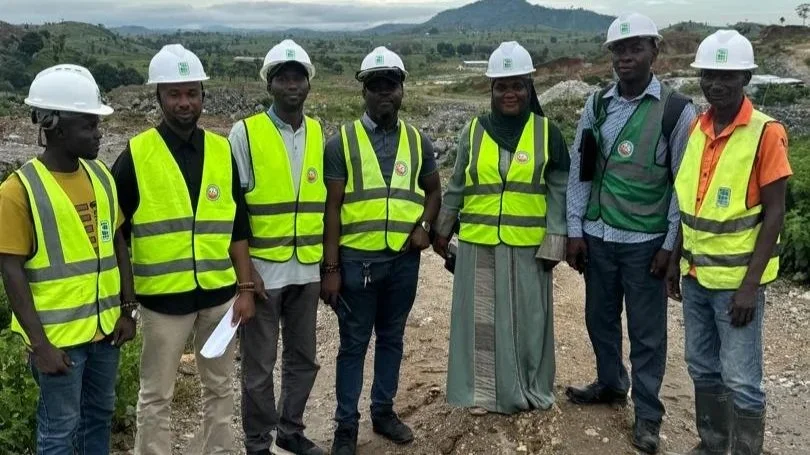
FCTA officials inspect quarry operations in Bwari
The Federal Capital Territory Administration (FCTA) has intensified inspections of quarry and mining operations in Bwari Area Council, warning operators that failure to comply with safety, environmental and statutory requirements could lead to sanctions, including suspension or closure.
/ You Might Also Like /




The inspection was conducted by the Department of Solid Minerals and Allied Matters (DSMAM) as part of efforts to strengthen regulatory compliance, protect workers and host communities, and reduce environmental risks associated with mining activities in the FCT.
FCTA Inspects Quarry Sites in Bwari
The inspection team, led by Timothy Shemang, Deputy Director of the Quarry and Economic Ecology Division, assessed operators against established safety and environmental standards.
Officials examined the use of personal protective equipment, safety arrangements, environmental management practices and the availability of required statutory documents.
They also verified operating licences, surface rent receipts and mine clearance permits as part of the exercise.
The FCTA said the inspections form part of its responsibility to ensure that mining activities within the territory operate within approved standards.
Operators Face Sanctions for Regulatory Breaches
The administration warned that quarry operators who fail to meet their statutory obligations could face enforcement action.
Shemang specifically said operators who fail to pay surface rent or obtain the required clearance permits risk sanctions, including suspension or closure.
The FCTA also said it would continue enforcing the Standard Operational Procedures approved for mining activities within the FCT.
The warning reinforces the importance of regulatory compliance for companies operating in the quarrying and mining sector, particularly as demand for construction materials continues to support quarrying activity around Abuja.
Some Quarry Sites Receive Compliance Notices
The inspection did not result in a blanket finding against all operators.
According to the FCTA, some of the sites inspected were operating in compliance with the required standards, while others received compliance notices over identified deficiencies.
The reported violations included inadequate use of personal protective equipment, insufficient safety signage and gaps in statutory documentation.
The administration said operators would be expected to address identified shortcomings and comply with the applicable regulatory requirements.
FCTA Raises Environmental and Community Concerns
The enforcement exercise also reflects concerns about the environmental consequences of poorly regulated quarrying and mining activities.
Quarry operations can involve excavation, blasting, heavy machinery, dust and significant alteration of surrounding land. Where operators do not follow approved procedures, these activities can create risks for workers, nearby communities and the environment.
The DSMAM also highlighted the need for greater regulation of industrial rock blasting, particularly in areas considered vulnerable to geological hazards.
For Abuja, where urban expansion is bringing residential development closer to previously undeveloped areas, effective management of mining activities is increasingly important.
Quarrying Has Direct Implications for Construction
Quarry operations play an important role in the construction supply chain because materials such as crushed stone and aggregates are used extensively in roads, foundations, concrete and other building works.
Abuja's continued infrastructure and property development therefore creates demand for quarry products.
However, stronger enforcement could affect operators that have been working without complete documentation or adequate safety and environmental systems.
For legitimate operators, effective regulation could help create a more predictable market by reducing competition from businesses operating outside established requirements.
Land Use Planning Will Become Increasingly Important
The expansion of Abuja's built-up areas means that the relationship between mining sites and residential development requires careful planning.
Quarrying activities need appropriate separation from residential communities, public facilities and environmentally sensitive areas.
As new housing developments expand towards areas such as Bwari and other parts of the FCT, land-use planning will become increasingly important to prevent conflicts between residential, industrial and extractive activities.
Developers and property investors also need to consider surrounding land uses when assessing development opportunities.
Regulation Could Support Responsible Development
The FCTA said the objective of its enforcement programme is not only to sanction non-compliant operators but also to promote responsible mineral-resource management.
Shemang urged mining companies to cooperate with DSMAM and comply with regulatory requirements, stressing that safe mining practices are necessary to protect workers and host communities.
The approach could support a more sustainable construction-material supply chain if enforcement is applied consistently and legitimate operators receive clear guidance on compliance.
Implications for Abuja's Property Market
The enforcement action has a wider relevance to Abuja's property market because mining and quarrying can influence the suitability and long-term development potential of surrounding land.
Stronger regulation can reduce risks associated with unsafe operations, uncontrolled blasting and environmental degradation, helping to protect communities as urban development expands.
At the same time, developers should undertake appropriate due diligence before acquiring land near active or former quarry sites, particularly where geological conditions or previous extraction activities could affect construction.
For policymakers, the challenge is to balance the need for construction materials with the need to protect communities and maintain orderly urban expansion.
Conclusion
The FCTA's intensified inspection of quarry and mining sites in Bwari signals a stronger regulatory approach to extractive activities within the Federal Capital Territory.
Operators have been warned that failures involving licensing, surface rent, clearance permits, safety equipment and other statutory requirements could result in sanctions, including suspension or closure.
For Abuja's construction and property sectors, effective regulation will be important in maintaining a reliable supply of quarry materials while ensuring that mining activities do not undermine environmental safety, community welfare or long-term urban development.
READ MORE