50 Homes Delivered for Fallen Heroes’ Wives as Housing Partnership Expands

FHFL, PHDL and NASENI Provide 50 Homes for Fallen Heroes’ Families
Fifty two-bedroom, energy-efficient homes have been delivered to wives of fallen Nigerian heroes in Oyo State, providing secure accommodation to families facing the financial and social pressures that follow the loss of their primary breadwinners.
/ You Might Also Like /




The homes were developed through a partnership between Family Homes Funds Limited (FHFL), Post-Service Housing Development Limited (PHDL) and the National Agency for Science and Engineering Infrastructure (NASENI).
The housing units were recently commissioned in Idi-Ape, Akobo, Lagelu Local Government Area of Oyo State, in an intervention designed to provide long-term housing security for beneficiaries.
50 Energy-Efficient Homes Delivered in Oyo
The development comprises 50 two-bedroom detached homes designed with energy efficiency in mind.
The houses are expected to reduce the housing burden facing the beneficiaries by providing them with permanent accommodation and removing the need to meet recurring rental obligations.
For the widows, the intervention also provides greater residential security at a time when many are simultaneously dealing with household expenses, children’s education and other financial responsibilities following the death of their spouses.
The project therefore combines housing delivery with a broader social-support objective, particularly for households that may face difficulty securing adequate accommodation through conventional market channels.
Partnership Model Connects Housing With Social Protection
The project demonstrates the role that partnerships among housing institutions, development organisations and public agencies can play in addressing specific housing needs.
FHFL has positioned the intervention within its broader mandate to mobilise capital and support affordable housing delivery for low- and middle-income Nigerians.
The organisation said its support for the beneficiaries extends beyond the physical houses, with plans to support skills development and livelihood opportunities that can strengthen the families’ capacity for self-sustainability.
This approach broadens the role of housing from the provision of shelter to the creation of greater economic and social stability for vulnerable households.
Housing Intervention Targets Vulnerable Households
The development also highlights the importance of targeted housing programmes for households that may be underserved by Nigeria’s conventional housing market.
While much of Nigeria’s housing delivery is driven by commercial considerations, vulnerable groups often require interventions that combine affordability, financing, land access and social protection.
The homes delivered in Oyo provide a practical example of how targeted housing programmes can address the needs of a clearly identified beneficiary group rather than relying solely on broad housing-supply interventions.
Energy Efficiency Adds a Sustainability Dimension
The inclusion of energy-efficient features gives the project an additional sustainability dimension.
Energy costs remain an important component of household expenditure, while unreliable electricity supply often pushes households to rely on alternative and more expensive sources of power.
Energy-efficient housing can help reduce household energy requirements and operating costs over time, while also supporting wider efforts to improve the sustainability of Nigeria’s built environment.
This is increasingly relevant as developers and policymakers consider housing models that address both affordability and long-term operating costs.
Army Welcomes Housing Support for Fallen Personnel
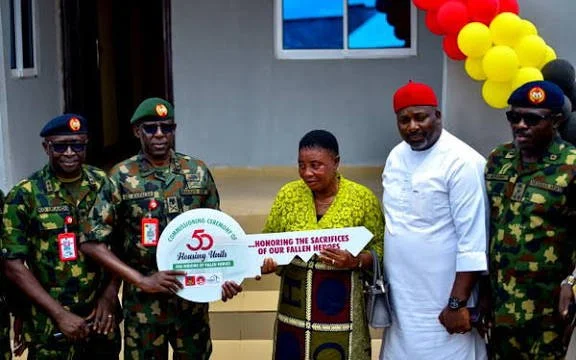
The houses were commissioned on behalf of the Chief of Army Staff, Lieutenant General Waidi Shaibu, by the General Officer Commanding, 2 Division, Nigerian Army, Major General Auwalu Mahmuda.
Mahmuda reaffirmed the Nigerian Army’s support for initiatives that provide housing and other forms of assistance to families of fallen personnel.
He described the intervention as practical support for families whose members had made significant sacrifices in service to the country.
The beneficiaries subsequently received the keys to their homes.
Housing Partnerships Could Support Wider Delivery
The Oyo development comes against the backdrop of a housing market where high construction costs, limited access to affordable finance and land-related challenges continue to constrain supply.
Partnerships such as this can provide an alternative route for delivering housing to specific groups while allowing participating institutions to combine their respective resources and capabilities.
For Nigeria, expanding such models could help complement larger government housing programmes by directing housing support towards groups with clearly defined needs.
The approach could also be adapted for other vulnerable categories, provided projects maintain transparent beneficiary selection, sustainable financing and appropriate standards for construction and long-term maintenance.
Beyond Housing, the Project Addresses Household Stability
The significance of the development extends beyond the 50 houses delivered.
For the beneficiaries, homeownership removes a recurring rental obligation while providing a stable environment for families to live and plan for the future.
From a housing-policy perspective, the project demonstrates how affordable and social housing can be integrated with broader welfare interventions.
The combination of secure accommodation, energy efficiency and proposed livelihood support creates a more comprehensive intervention than housing delivery alone.
Outlook
The delivery of the 50 homes in Oyo highlights the potential for institutional partnerships to address targeted housing needs while supporting wider social and economic objectives.
Although the scale remains modest compared with Nigeria’s broader housing shortage, the project provides a practical model for linking housing finance institutions, development partners and public agencies around clearly identified beneficiaries.
For Nigeria’s housing sector, the broader challenge will be scaling such interventions while ensuring that affordability, sustainability and long-term maintenance remain central to delivery.
The Oyo project shows that targeted housing partnerships can provide immediate relief to vulnerable households while contributing to the wider objective of expanding access to secure and dignified housing.
READ MORE