
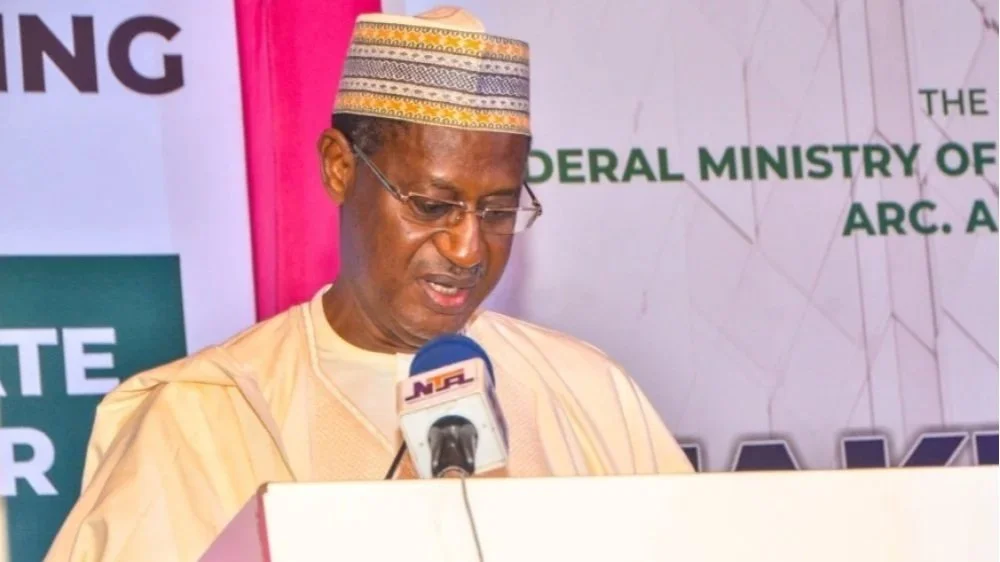
Dangiwa Highlights Transformative Scope of Tinubu’s Renewed Hope Housing Programme
The Federal Government’s Renewed Hope Housing Programme is being positioned as a transformative national initiative designed not only to bridge Nigeria’s significant housing deficit but also to drive economic growth, job creation, and social inclusion, according to Minister of Housing and Urban Development, Ahmed Dangiwa.
Speaking on the objectives of the programme, Dangiwa emphasised that Renewed Hope is more than a conventional housing scheme. It is a comprehensive intervention designed to facilitate wealth creation, reduce poverty, and expand equitable access to homeownership across all income levels. The minister highlighted that previous housing initiatives had faced public scepticism, but the current programme introduces innovative financial and operational models to ensure transparency and sustainability.
The programme incorporates several financing mechanisms, including single-digit interest mortgages, rent-to-own schemes with zero initial down payment, and a Digital Housing Portal to streamline access and improve transparency. These measures are intended to address persistent barriers to affordable housing and expand opportunities for Nigerians to acquire property without excessive financial burden.
Three-Tiered Housing Delivery Model
Dangiwa detailed the programme’s structure, comprising three distinct components:
Renewed Hope Cities: Large-scale, master-planned developments of at least 1,000 housing units in major urban centres, targeting high-income residents and diaspora investors. These projects are expected to stimulate local economies and create employment opportunities.
Renewed Hope Estates: Medium-scale developments of approximately 250 units per state capital, designed for middle-income earners such as civil servants, educators, healthcare workers, artisans, and traders. The estates aim to position homes closer to workplaces, improving commuting efficiency and quality of life.
Renewed Hope Social Housing Estates: Targeted at low-income and vulnerable populations, these initiatives involve the construction of 100 homes per local government area, covering all 774 LGAs nationwide. This component represents the first structured attempt to distribute housing equitably and inclusively across Nigeria.
Public-Private Partnerships as a Cornerstone
The minister emphasised that the success of the programme hinges on collaboration with private developers and investors through public-private partnerships (PPPs). By leveraging private capital and expertise, the government seeks to ensure scalability, operational efficiency, and long-term sustainability of housing delivery.
With Nigeria facing a housing deficit exceeding 20 million units, Dangiwa noted that the Renewed Hope Housing Programme is a deliberate effort to reset the sector. Beyond construction, the initiative aims to upgrade financing systems, enhance urban planning, and stimulate economic activity across related industries such as construction, materials supply, and financial services.
Conclusion
The Renewed Hope Housing Programme represents a strategic policy shift in Nigeria’s housing sector, combining accessibility, economic empowerment, and social equity. Its multi-tiered approach, innovative financing, and reliance on PPPs position the initiative to reshape the housing landscape, delivering both social and economic returns for Nigerians.
