
753 Housing Estate Trial: Witness Denies Direct Payments From Ex-CBN Governor Emefiele
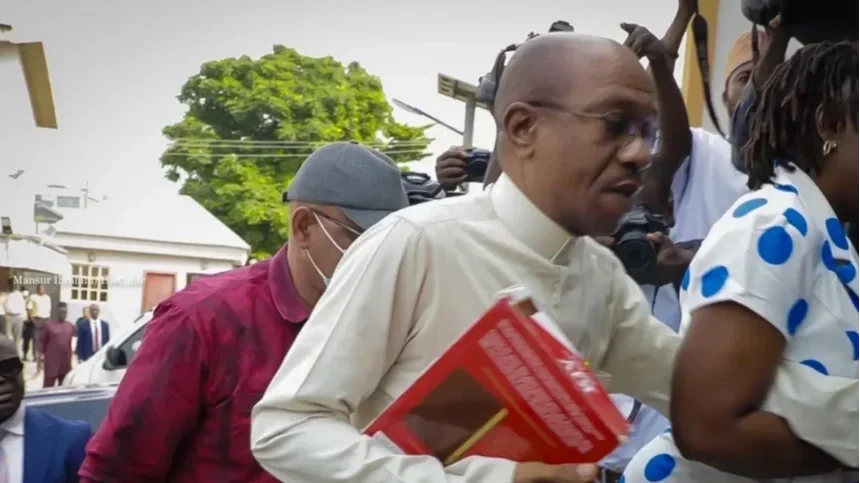
Third Prosecution Witness Rejects Claim of Direct Payments From Emefiele in Court
In a significant development in the trial of former Central Bank of Nigeria (CBN) Governor Godwin Emefiele, a prosecution witness has denied receiving funds directly from the defendant in relation to the 753-unit housing estate controversy currently before the Federal Capital Territory (FCT) High Court in Abuja.
The ongoing case involves allegations by the Economic and Financial Crimes Commission (EFCC) that Emefiele unlawfully acquired the expansive housing estate in the Lokogoma District of Abuja through proxy channels, abusing his office for personal enrichment — charges the former CBN governor has consistently denied.
Witness Testimony Highlights Third-Party Routing of Funds
During proceedings on 16 February 2026, Richard Agulu, a former staff member of Zenith Bank now employed at the Nigerian Communications Commission, appeared as the third prosecution witness (PW-3). Testifying under cross-examination by defence counsel Matthew Burkaa SAN, Agulu maintained that he never received any money directly from Emefiele himself. Instead, he said any transactions were executed based on instructions relayed through Emefiele’s personal assistant, Eric Ocheme.
When pressed on whether he had personally seen Emefiele give funds to Ocheme for onward delivery to him, Agulu replied that he had not observed such an exchange, but that the instructions for the transactions came through that intermediary channel.
Details on Transaction Execution and Evidence
Agulu acknowledged that the banking transactions were carried out using formal instruments such as cheques, and not via informal messages or notes. However, he also admitted that neither Emefiele nor Ocheme was an account holder of the involved accounts, which required him to include the names of legitimate account proprietors Chukwuma Okpala of Kelvito Integrated Services and Peter Adebayo of Ifeadigo Integrated Services on deposit slips when processing payments.
During proceedings, an extrajudicial statement previously made by the witness to the EFCC was tendered and admitted as evidence after initial objections by prosecution counsel, who later withdrew their opposition. The court marked the document as Exhibit G, and hostilities over admissibility were resolved without hindrance to its inclusion.
Legal Context and Next Steps
The case against Emefiele, which includes eight counts relating to alleged property fraud and unlawful enrichment, has attracted widespread public and legal interest. The 753-unit estate located on Plot 109, Cadastral Zone C09, Lokogoma, FCT measures over 150,000 square metres and has been seized by authorities as part of the anti-corruption prosecution.
Under cross-examination, Agulu struggled to recall specifics such as phone contacts or exact transactional frequency but reiterated that his actions were pursuant to instructions he attributed to the defendant, albeit conveyed via intermediaries.
Justice Yusuf Halilu subsequently adjourned the matter to 22 April 2026 for continuation of the witness’s cross-examination and further proceedings.
Broader Implications
The testimony adds nuance to the prosecution’s case, underscoring the complexities of tracing alleged financial flows in high-profile corruption trials. It illustrates the legal challenges of documenting direct involvement, especially when intermediaries are used a scenario common in cases alleging financial impropriety by public officials.
As the courtroom drama unfolds, both prosecution and defence teams are expected to build their arguments around witness credibility, documentary evidence and the interpretation of financial instruments used in the transactions linked to the 753-unit estate.
