
Property Demolitions and Market Volatility: The Hidden Cost of Nigerian Land
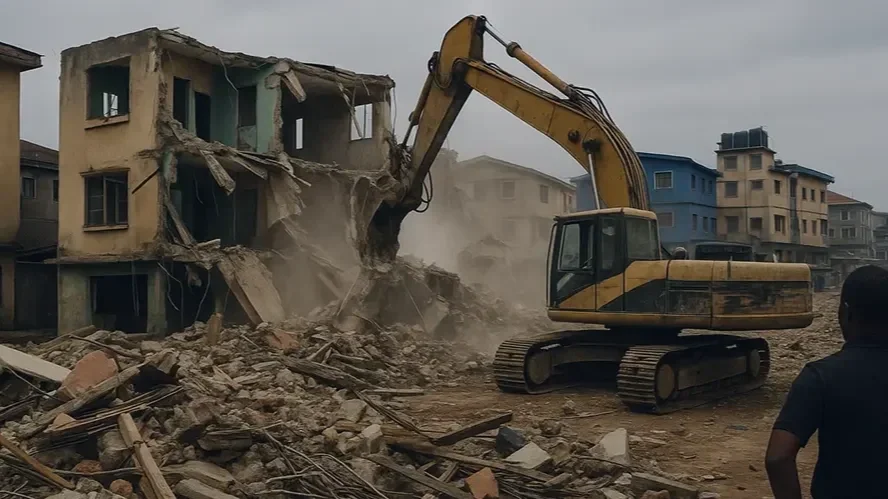
On-going Demolition
Land in Nigeria’s primary and secondary cities is increasingly being priced as a premium asset, with values in some locations tripling over the last 12 months. In Lagos, Abuja, and Port Harcourt, land prices have surged by nearly 300 percent, driven by high demand from real estate developers, diaspora investors, and individuals seeking a hedge against rampant inflation and currency devaluation.
Exponential Price Growth in Prime Locations
According to Chudi Ubosi, Principal Partner at Ubosi Eleh & Co., the escalation in property values is "beyond comprehension." For example, land on Cooper Road in Ikoyi, which was priced at ₦800,000 per square metre (sqm) in January 2024, has skyrocketed to ₦3.5 million per sqm by early 2026. Similarly, in mainland Lagos, land in Ikeja GRA has moved from ₦600,000 per sqm to ₦1.5 million per sqm within the same period.
These increases are largely attributed to the devaluation of the Naira and the conventional tendency of property values to mirror inflationary trends. In many high demand areas of Lagos, a full plot of land now commands approximately ₦200 million, while half-plots frequently exceed ₦80 million.
The Human and Economic Toll of Demolitions
However, the "real cost" of land extends beyond financial figures. Analysts argue that the true price includes the widespread psychological trauma, family dislocations, and investment losses stemming from government led demolitions. It is estimated that at least 2,500 houses have been affected by recent demolition exercises across cities including Lagos, Abuja, Onitsha, and Enugu, with the total value of lost property estimated at over ₦2 trillion.
In Lagos, the impact has been particularly severe in communities such as Mile 12, Makoko, and those along the Lagos-Calabar Coastal Road. Reports indicate that these exercises have not only led to homelessness and job losses but have also resulted in fatalities due to shock and health complications.
Policy and Investor Confidence
The trend of "mindless" demolitions often executed under the guise of urban renewal is raising concerns among stakeholders regarding investor confidence in the real estate market. While some experts acknowledge that slums can impede modern urban planning, others, such as retired CBN Director Adebanjo Emmanuel, contend that urban renewal should be better programmed, offering longer notice periods and possible financial assistance for displaced residents.
As land prices continue to soar, the tension between infrastructure development and social equity remains a critical challenge for Nigerian urban policy. The current climate of apprehension suggests that while land remains a highly profitable investment, the associated risks of sudden administrative action are becoming an increasingly significant factor in the market’s real cost.
