Dangote Cement Wins Commendation from the FG for Successful Delivery of Social Projects in Benue State
Dangote Cement Wins FG Commendation for Benue Social Impacts
The Federal Government has commended Dangote Cement Plc for the successful delivery of multi-million-naira social interventions in its Gboko host communities in Benue State. Speaking at the inauguration of the projects on January 8, 2026, the Minister of Solid Minerals Development, Dr Dele Alake, confirmed that the company is meeting its statutory obligations under the Community Development Agreement (CDA) framework. These interventions, which include water infrastructure, expanded scholarship schemes, and skill acquisition programmes, are part of a broader federal policy requiring mining companies to reinvest a portion of their profits into host communities to ensure sustainable economic development.
CDA Compliance and Infrastructure Delivery
The current projects are the result of a five-year Community Development Agreement established between Dangote Cement, the Federal Ministry of Solid Minerals Development, and six host communities, including Mbayion, Mbatur, and Pass Brothers. A primary focus of the 2025/2026 cycle was addressing potable water scarcity in the region.
According to Dr Johnson Kor, Head of Social Performance at the Dangote Cement Gboko Plant, the newly commissioned infrastructure includes both motorised and solar-powered boreholes. These facilities were strategically located in the Pass Brother, Mbaakpoghol-Mbatyu, Mbaswa-Mbatser, and Agboghol-Amua communities, areas that have historically struggled with water access despite their proximity to the River Benue. Beyond water, the company is currently executing electricity projects intended to integrate these rural hubs into the state power grid.
Human Capital Development and Economic Empowerment
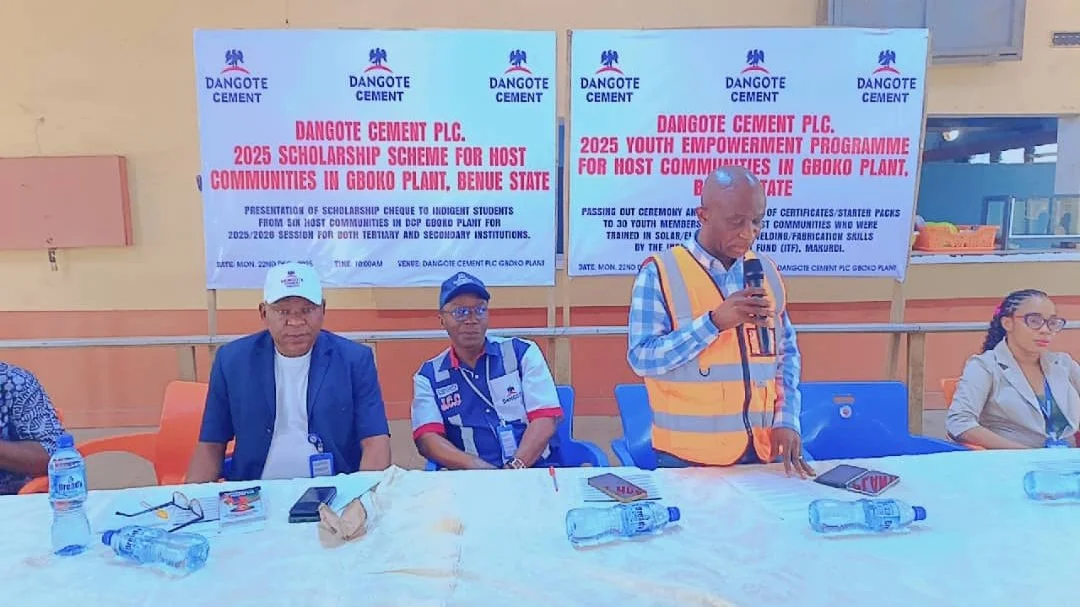
In addition to physical infrastructure, Dangote Cement has significantly scaled its human capital investments. The company’s scholarship fund was reviewed upward to ₦28,800,000 for the current academic session, representing a tripling of previous years' allocations. This expansion aims to ensure equity across all six host communities, moving beyond immediate plant neighbours to include the broader mining districts.
Under the supervision of the Industrial Training Fund (ITF), the company also graduated a new cohort of participants from its Youth Skill Development Programme. To ensure the transition from training to self-reliance, graduands were provided with certificates and "starter packs" for immediate skill application. Other ongoing social investments include:
Women Empowerment Programme: Targeted at 150 beneficiaries.
Farmers Empowerment Programme: Aimed at improving agricultural yields for 50 local farmers.
Youth Empowerment Programme: A dedicated track for 30 youths focused on vocational self-sufficiency.
Regulatory Context and Sectoral Impact
The Minister’s commendation comes amid a rigorous federal cleanup of the mining sector. The Ministry of Solid Minerals Development had previously issued a December 31, 2025, deadline for all licensed mining and quarrying firms to finalise their CDAs or face license revocation. Recent data indicates that while over 2,400 mineral titles were issued since 2023, only a fraction had signed formal CDAs by late 2025.
By achieving full compliance and project delivery, Dangote Cement serves as a benchmark for Environmental, Social, and Governance (ESG) standards in Nigeria’s solid minerals sector. The government has urged host communities to take "ownership" of these assets to ensure their longevity, viewing such partnerships as essential for mitigating the "resource curse" and fostering peaceful coexistence in mining regions.
Conclusion
The 2026 inauguration of CDA projects in Benue State underscores a shift in Nigeria's mining landscape toward mandatory corporate social reinvestment. As the Federal Government continues to implement satellite surveillance and stricter enforcement of mining regulations, the "Dangote Model" of community engagement provides a roadmap for balancing industrial extraction with rural development. For investors and policymakers, the sustainability of these community-led projects remains a critical metric for the long-term stability of the Nigerian solid minerals market.