The World Economic Forum’s Annual Meeting in January 2026 gathered more than 60 heads of state and hundreds of chief executives under the theme “A Spirit of Dialogue.” The meeting took place amid what the Forum’s Global Risks Report 2026 calls an “Age of Competition”, a period marked by geoeconomic confrontation, weakening multilateral cooperation and intensifying volatility. In this fragmented environment, Nigeria House, the country’s first sovereign pavilion at Davos, announced Nigeria’s intention to be a proactive player in shaping global conversations rather than a passive observer. This article interprets the global signals from Davos 2026 and proposes strategies to reimagine Nigeria’s housing sector at home.
The Davos 2026 context: a fragmenting world economy
1.1 An age of competition and structural volatility
The Global Risks Report 2026 paints a world of turbulence. Surveying more than 1 300 global leaders, the report finds that over half expect the next two years to be stormy and that geopolitical rivalry now tops the list of short term risks. Geoeconomic confrontation, driven by trade restrictions, investment controls and weaponised supply chains, is the most severe near term risk. Economic instability, inflation, debt sustainability concerns and asset bubbles also climb up the risk rankings. The report warns that the coming decade will likely be characterised by competing regional blocs rather than a cohesive rules based system; around 68 percent of experts anticipate a multipolar order. In short, the world is fragmenting.
The World Economic Forum’s Global Value Chains Outlook 2026 offers similar warnings. It notes that supply chains have entered a period of structural volatility and that nearly three quarters of business leaders now prioritise resilience investments. Tariff escalations and disruptions reshuffled more than $400 billion in trade flows in 2025, while shipping costs jumped 40 percent. The report argues that competitiveness will depend on foresight, optionality and ecosystem coordination, rather than on efficiency alone.
1.2 Nigeria’s new posture at Davos 2026
Against this backdrop, Nigeria’s delegation arrived at Davos with a markedly different tone. Time Africa described Nigeria House as an assertion that Africa’s largest economy will no longer accept being discussed in corridors or risk memos; it insists on direct, commercial engagement. Rather than focusing on aid, Nigerian leaders spoke in transactional, reform driven language, covering agriculture, infrastructure, financial services, renewable energy and digital transformation. This posture acknowledges that the era of “potential” is over; investors now demand structural proof, predictable regulation and execution. The presence of private sector leaders alongside officials underscores that Nigeria understands global investors value credible partnerships, not just promises.
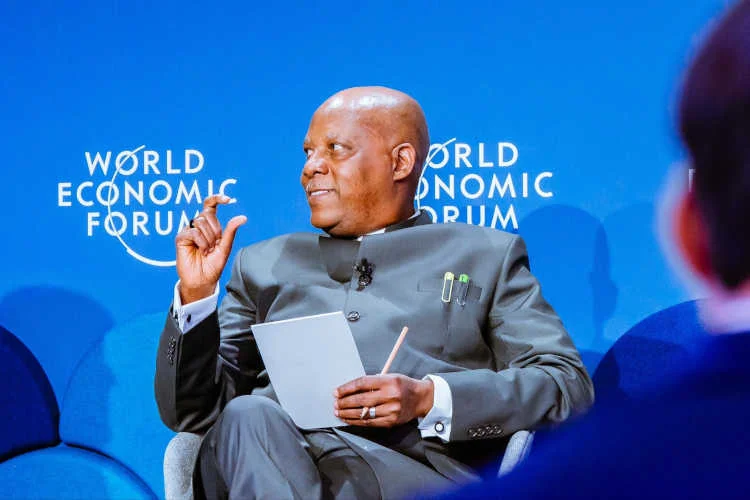
Vice President Kashim Shettima, in inaugurating Nigeria House, emphasised that the pavilion reflects Nigeria’s resolve “to take a front line seat in the discourse of the global economy”. He invited the global business community to collaborate with Nigeria, noting that the pavilion must derive its essence from the private sector. Shettima pointed out that Nigeria’s economy expanded by 3.9 percent in 2025, the fastest pace in over a decade, and that inflation, which exceeded 30 percent in late 2024, eased considerably by the end of 2025. Foreign reserves rose above $45 billion, signalling improved macroeconomic buffers. These indicators helped Nigeria project stability and a readiness for investment.
Nigeria’s Finance Minister Wale Edun used Davos to articulate a proactive approach to risk management. He identified three priorities: macroeconomic discipline to build buffers, economic diversification to reduce reliance on narrow external flows and sustained dialogue to preserve openness and investment in a fragmented economy. Edun stressed that Nigeria will shift from debt financed spending to investment led growth; he said the government is determined to rely less on borrowing and to drive domestic and foreign investment. He argued that Nigeria’s presence in Davos signals a “new narrative of stability and opportunity”.
The World Trade Organisation’s Director General, Ngozi Okonjo Iweala, further highlighted that Nigeria must deliberately target global investors and reposition itself within reconfigured supply chains. Rising geopolitical tensions and trade restrictions have accelerated “China + 1” sourcing strategies; companies are diversifying production hubs. Okonjo Iweala urged Nigeria to map opportunities and actively court investors in renewable energy, textiles, pharmaceuticals and manufacturing to capture a share of these supply chains. She emphasised that reforms must translate into job creation and credible execution.
The state of Nigeria’s housing sector in 2026
While Nigeria spoke confidently in Davos, the reality at home is more nuanced. The country faces a severe housing crisis characterised by a massive deficit, inadequate housing stock and structural bottlenecks in land administration and mortgage finance.
2.1 Data, deficits and inadequacy
Official figures on Nigeria’s housing deficit vary widely, but estimates converge around tens of millions of units. BusinessDay notes that the housing deficit, estimated at 17 million units a decade ago, has grown to about 28 million units. This figure reflects both the backlog of unmet demand and the number of households living in inadequate conditions. Meanwhile, the Federal Ministry of Housing and Urban Development reported in December 2025 that roughly 15.2 million housing units are structurally inadequate. They exist physically but do not meet standards for safety, habitability or access to basic services. The ministry emphasised that Nigeria’s housing challenge is not only about building new homes but also about upgrading existing stock and regenerating deteriorated neighbourhoods.
2.2 Land administration and dead capital
Less than 5 percent of land parcels in Nigeria are formally titled. A recent calculation estimates that this leaves between $150 billion and $300 billion worth of property effectively dead capital that cannot be leveraged, mortgaged or securely transferred. The Land4Growth programme aims to digitise land records and deliver one million digital land titles across up to 20 states, a potentially transformational step if implemented transparently. Digital records can reduce fraud, speed transactions, provide collateral for lending and support property taxation.
2.3 Mortgage finance and affordability
Mortgage finance remains severely underdeveloped. Nigeria’s mortgage to GDP ratio is about 0.5 percent, compared with far higher ratios in South Africa and many other emerging markets. The Federal Mortgage Bank offers loans under the National Housing Fund at rates of 6 to 7 percent, but fewer than 20 000 Nigerians access these mortgages annually. Over 90 percent of Nigeria’s workforce operates in the informal economy and lacks formal income documentation, excluding them from mortgage eligibility. Rental markets are also strained; rents in Lagos and Abuja have been rising by 15 to 20 percent per year and landlords commonly demand one or two years’ rent in advance. Tax incentives under the Nigeria Tax Act 2025 allow small businesses to deduct a portion of rent from taxable income, but the relief is limited when rents far exceed the deduction cap.
2.4 Policy reforms underway
2026 marks the convergence of several housing related reforms. The Nigeria Tax Act 2025 took effect on 1 January 2026, offering limited rent and mortgage deductions. The Ministry of Finance Incorporated Real Estate Investment Fund has been launched to mobilise long term capital for housing. The Land4Growth digital titling programme is rolling out across states. The Federal Mortgage Bank of Nigeria is undergoing recapitalisation, and a National Housing Data Centre is being established to provide evidence based policy. These initiatives represent the broadest housing reform effort in decades but hinge on execution and coordination. Industry leaders caution that Nigeria’s housing crisis is not primarily a technical problem but a test of political will and implementation.
Implications of global fragmentation for Nigeria’s housing sector
The global trends discussed at Davos have direct bearing on Nigeria’s housing industry. Fragmented supply chains and geoeconomic competition influence the cost of construction materials, access to finance and investor risk appetite. Three implications stand out:
Supply chain resilience becomes a priority. As the WEF report notes, 74 percent of executives now prioritise resilience over efficiency. Tariff escalations and shipping disruptions reshuffled $400 billion in trade flows in 2025. For Nigeria’s housing sector, which depends on imported steel, cement additives, solar panels and construction equipment, supply chain volatility means material cost spikes and project delays. Building local manufacturing capacity and diversifying import sources are therefore strategic priorities.
Investment is guided by risk adjusted returns and credible execution. Nigeria’s Davos delegation highlighted stability, reforms and growth to reassure investors. However, as Time Africa observed, the world is no longer buying promises; investors demand predictability, enforcement and timelines. Without credible execution of land reforms, housing finance innovations and data transparency, global capital will remain hesitant.
Fragmentation offers openings for regional value chain positioning. Okonjo Iweala’s call to target global supply chains reflects a broader trend: firms are seeking “China + 1” or “friend shoring” alternatives. Nigeria can attract investment in construction materials such as cement and roofing, renewable energy components and prefabricated housing parts. Capturing these supply chains will require favourable industrial policies, infrastructure and clear incentives.
Post Davos strategies to reimagine Nigeria’s housing sector
Drawing on the Davos discussions and Nigeria’s domestic context, the following strategies can help reimagine the housing sector in a fragmented global economy:
4.1 Build resilience through local production and diversified sourcing
Nigeria should invest in domestic manufacturing of key building materials such as cement, steel rebar, roofing sheets, bricks and prefabricated components. Leveraging abundant limestone deposits and the country’s energy transition plans can reduce import dependence and mitigate global supply chain shocks. Partnerships with global firms seeking alternative manufacturing hubs, an opportunity highlighted by Okonjo Iweala, can catalyse investment. Meanwhile, diversifying import sources such as sourcing solar panels from multiple countries hedges against geopolitical disruptions.
4.2 Prioritise execution of land and data reforms
Successful housing reform hinges on secure land tenure and transparent data. The Land4Growth programme must deliver digital titles quickly, with particular attention to informal settlements. State governments should view digitisation as a means to reduce corruption and unlock value, not as another revenue extraction opportunity. The National Housing Data Centre should publish regular, high quality data on housing supply, demand, prices and demographics, enabling investors and policymakers to make evidence based decisions.
4.3 Expand mortgage access and alternative finance
To tackle the 0.5 percent mortgage to GDP ratio, Nigeria needs inclusive financing models. Options include incremental housing finance, cooperative housing schemes and rent to own programmes. Formal lenders should integrate informal income verification such as mobile money transaction histories to extend credit to the informal workforce. The MOFI Real Estate Investment Fund, when fully capitalised, can provide long term patient capital to developers, but it should prioritise projects that produce affordable, quality housing.
4.4 Foster public private partnerships and diaspora investment
The private sector must be at the centre of housing delivery. Nigeria House underscored that government can create frameworks and de risk environments, but only enterprise can animate growth and scale opportunity. Public private partnerships should be structured transparently, with clear risk sharing and performance benchmarks. Nigeria’s large diaspora presents another source of capital; structured diaspora bonds or housing investment vehicles can channel remittances into housing projects. Credible governance and currency stability, noted by Shettima through improved reserves, will be critical to attracting diaspora investors.
4.5 Embed climate resilience and technological innovation
Environmental risks dominate the long term outlook. Housing projects should integrate climate resilient design such as flood resistant materials, passive cooling and rainwater harvesting and align with Nigeria’s renewable energy ambitions. Digital technologies, from building information modelling to blockchain based land registries, can improve efficiency, reduce corruption and enhance trust. Proptech startups that address property management, rental platforms and mortgage underwriting deserve policy support and venture capital.
Conclusion
The conversations at Davos 2026 revealed a world defined by competition, fragmentation and heightened risk. Yet they also offered Nigeria a platform to reset its narrative. Nigeria House signalled a shift from rhetoric to execution; Wale Edun’s emphasis on discipline and diversification, Shettima’s invitation to partnership and Okonjo Iweala’s call to target supply chains collectively chart a path forward. For the housing sector, these signals translate into concrete actions: building local resilience, reforming land governance, expanding inclusive finance, mobilising private and diaspora capital and embedding climate and digital innovations.
As Nigeria reimagines its housing sector in a fragmented global economy, the measure of success will not be in speeches but in homes built, communities upgraded and trust earned. Delivering on these fronts will demonstrate to investors and citizens alike that Nigeria’s commitments at Davos are more than promises. They are the foundation of shared prosperity.