
Monetary Inflation vs Landlord Inflation: Inside Nigeria’s Rent Crisis
Nigeria’s cost of living crisis has taken many forms, but few issues have generated as much anxiety as the sudden and severe rise in rent across the country’s major cities. While official inflation remains high, it does not come close to explaining what tenants in Lagos and Abuja are facing on the ground. New analysis from Nigeria Housing Market shows that rent increases in both cities have broken away from the broader economy and are now operating in their own inflationary regime.
In practical terms, tenants in these two cities are facing rent jumps that are roughly three to four times higher than official inflation. This gap is what we describe as Landlord Inflation. It is the portion of rent inflation that cannot be explained by macroeconomic prices and is instead driven by landlord behaviour, expectations and informal market dynamics. Unlike monetary inflation, which affects food, transport and household goods, Landlord Inflation reflects the unique power imbalance and structural pressures within Nigeria’s urban housing markets.
This report explores that divergence using tenant level evidence from Lagos and Abuja, combined with the newly rebased Consumer Price Index released by the National Bureau of Statistics. With official headline inflation at 24.48 percent, Lagos tenants in our sample faced average rent increases of 105.6 percent, while Abuja tenants experienced an average jump of 81.1 percent. These are not isolated cases. They represent a pattern of citywide escalation that reveals a housing market moving independently of Nigeria’s broader economic indicators.
Understanding the New Inflation Baseline
In early 2025, the NBS introduced a rebased Consumer Price Index that better reflects current spending patterns in Nigeria. The first set of numbers under the new 2024 base year show:
Headline inflation: 24.48 percent
Food inflation: 26.08 percent
Core inflation: 22.59 percent
These figures represent the average increase in the cost of goods and services compared to the previous year. They form the benchmark that should, under normal market conditions, influence rent adjustments. If rent were simply following monetary inflation, tenants would expect an increase somewhere around 20 to 30 percent.
But housing in major Nigerian cities no longer behaves like a normal market.
What Lagos and Abuja Tenants Actually Faced in 2025
Our analysis draws on a set of verified rent increase reports collected from multiple tenants across both Lagos and Abuja. While each case reflects a different neighborhood, income level and property type, the pattern that emerges is remarkably consistent. Across the sample, tenants reported steep rent adjustments that far outpaced the broader economy. Many Lagos respondents described rent doubling within a single cycle, while several Abuja tenants faced increases ranging from moderate but still inflation beating adjustments to extreme jumps exceeding one hundred percent. The individual stories differ, but together they reveal a market where rent inflation has become largely detached from official inflation trends.
Instead of the gradual adjustments one might expect in a high inflation environment, tenants in both cities encountered sudden, sharp revisions that reset the baseline for entire buildings. These lived experiences give context to the quantitative averages presented later in this report, showing not only the scale of the increases but also the widespread nature of the pressure. Even without disclosing every datapoint, the collective evidence makes one conclusion clear: rent in Lagos and Abuja is rising far faster than any macroeconomic indicator would reasonably justify.
CPI vs Rent: The Scale of the Divergence
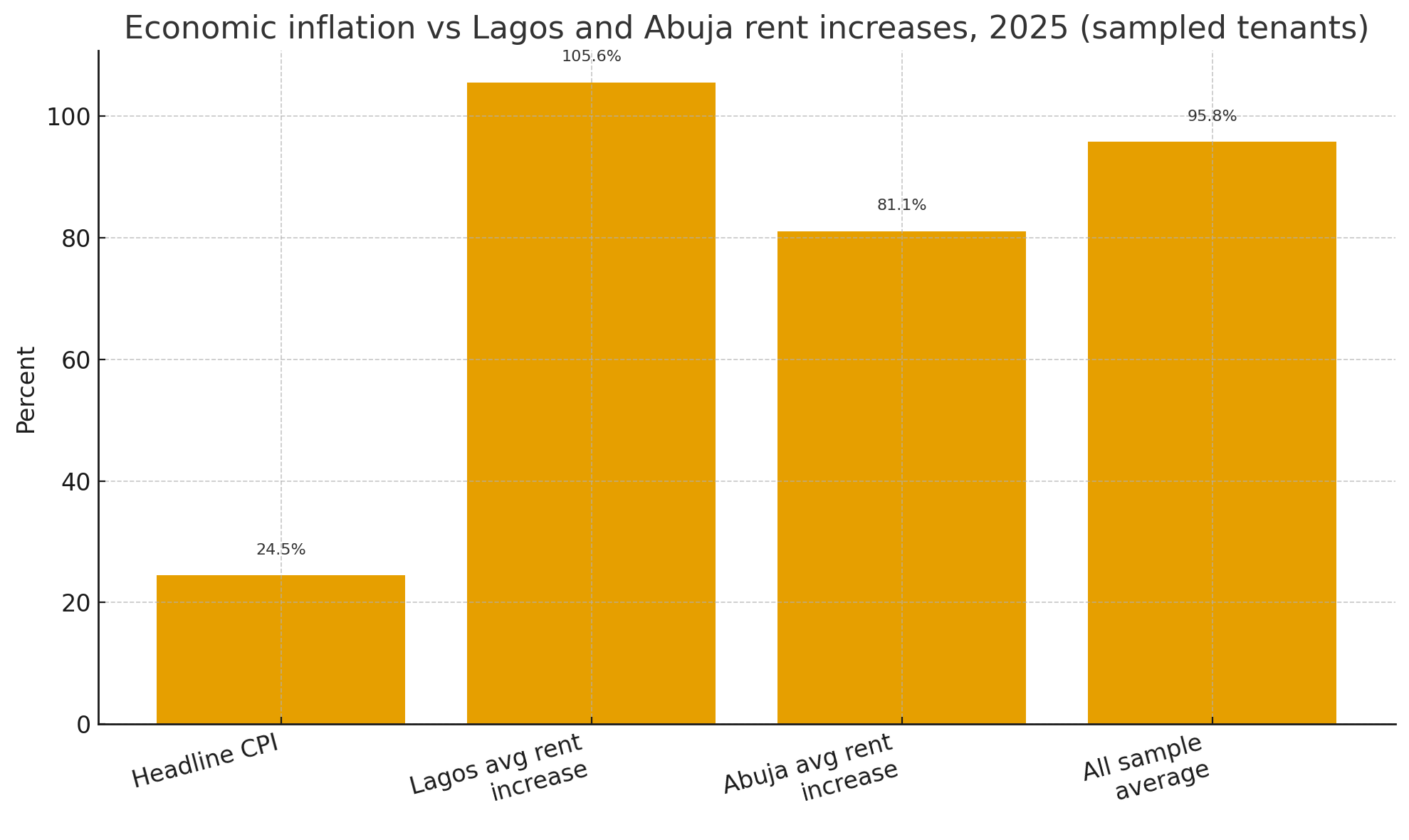
Figure 1 compares CPI to the average rent increases from our Lagos and Abuja tenant samples.
Key takeaway:
Both Lagos and Abuja display rent inflation that is more than triple Nigeria’s official inflation. Lagos stands above 105 percent, Abuja above 81 percent, while the CPI is 24.48 percent. This means tenants in Nigeria’s two most important cities are not simply experiencing inflation. They are facing a completely different economic environment within the housing market.
The Landlord Inflation Gap
To illustrate how much of the rent increase is not explained by inflation, we define the Landlord Inflation Gap as:
Landlord Inflation Gap = Average rent increase minus CPI
Using CPI of 24.48 percent, the gap becomes:
Lagos: 81.1 percentage points of excess rent inflation
Abuja: 56.6 percentage points of excess rent inflation
This means landlords are raising rent at rates that go far beyond increases in their own costs.

Figure 2. Landlord inflation gap in Lagos and Abuja, 2025 (sampled tenants)
In both cities, the CPI portion is small compared to the excess portion. In Lagos, the excess segment is more than three times the size of the economic inflation block. Abuja follows a similar pattern, though less extreme.
The Full Distribution of Rent Increases
Averages often hide the severity of outliers. To give a more transparent view, Figure 3 shows all Lagos and Abuja rent changes sorted from smallest to largest.

Distribution of rent increases among Lagos and Abuja tenants
Key observations from the distribution:
No tenant in the sample saw an increase below 42.9 percent.
The central cluster sits between 60 and 100 percent.
The upper tail includes dramatic jumps of 150 percent and 166.7 percent.
This distribution confirms that the problem is not driven by a single outlier pushing the average higher. High increases are widespread, structural and consistent across neighborhoods.
Why Rent Is Detached from the Economy
The gap between CPI and rent is not simply a data anomaly. It reflects deeper pressures inside Nigeria’s urban housing markets.
New tenant prices are resetting entire buildings
When one new tenant pays a high rent, landlords often issue notices to old tenants informing them of a new building wide rate. Several respondents described identical stories: “New tenants are paying the new rate so old tenants must do the same or move out.”
Landlords are pre pricing future risk
Currency volatility, maintenance uncertainty and inflation expectations push landlords to raise rent now rather than wait for further economic turbulence. This fuels front loaded rent increases.
Limited regulation or enforcement
Existing tenancy laws are rarely enforced. There is no effective monitoring of rent increase ceilings or landlord practices, allowing wide discretionary pricing.
Demand remains stronger than supply
Despite the cost of living crisis, demand in Lagos and Abuja is anchored by job concentration, business activity and the lack of affordable alternatives near city centers. This keeps upward pressure on prices.
Rent in Nigeria’s major cities has entered a separate inflationary regime, one that is shaped less by economic fundamentals and more by landlord expectations, market power imbalances and structural housing shortages. Lagos and Abuja tenants are experiencing rent increases far above inflation, with average hikes of 105.6 percent and 81.1 percent, compared to a national inflation rate of 24.48 percent.
This first part of NHM’s special report series provides a clear baseline for understanding the scale of the problem. Future reports will explore how these dynamics play out across other cities, how tenants are coping, and what evidence based policy tools could help stabilise the housing market.