
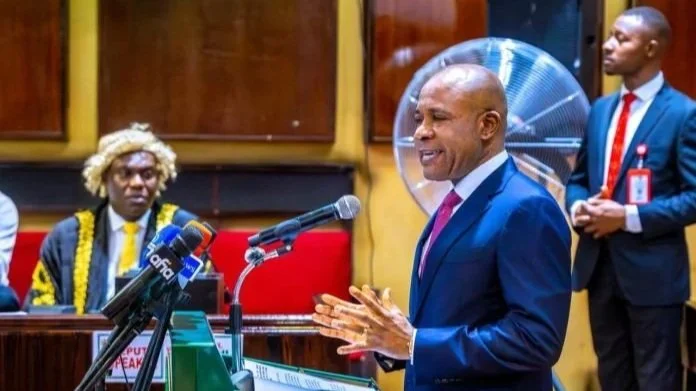
Enugu State has proposed a ₦1.62 trillion 2026 budget with 80% allocated to capital projects.
Enugu State’s 2026 budget proposal, valued at ₦1.62 trillion and presented by Governor Peter Mbah to the State House of Assembly, outlines one of the most ambitious infrastructure investment plans in the state’s history. The budget prioritises capital expenditure, dedicating approximately 80 percent to projects intended to accelerate economic expansion, stimulate real estate development, and enhance connectivity across the state.
Capital Investment Positioned as the Engine of Economic Growth
With ₦1.3 trillion allocated to capital projects, the budget reflects the administration’s strategy to drive GDP growth through large-scale infrastructure rollout. According to the government, this investment framework aims to expand internally generated revenue (IGR), improve market accessibility, and attract domestic and diaspora-led investments.
Road construction remains the core component of the capital plan. Key initiatives include:
Construction of 1,200 urban roads and several rural road networks
Completion of the 40-kilometre Owo–Ubahu–Amankanu–Neke–Ikem dual carriageway
Dualisation of the Abakpa Nike–Ugwogo Nike–Ekwegbe–Opi–Nsukka Road
Upgrades on the 21.65-kilometre Enugu–Abakaliki Expressway
These projects are designed to enhance mobility, reduce transportation costs, and unlock new corridors for residential and commercial development.
Real Estate Market Responds to Infrastructure Rollout
Local market data indicates a rapid appreciation of land values in areas directly impacted by road expansion. Properties in high-demand zones such as the Nike Lake Resort axis have seen price increases from approximately ₦8–11 million in 2023/2024 to ₦20–25 million in the current cycle. Real estate agents link this trend to increased investor confidence and stronger demand from both diaspora buyers and residents relocating from major cities like Lagos and Abuja.
Urban renewal is also central to the state’s agenda. The government has begun rehabilitation of 141 urban roads across 13 zones, backed by an allocation of ₦183 billion, with accompanying plans to modernise major markets and motor parks.
Transport Terminals, Housing, and New Enugu City Development
Beyond roads, the 2026 budget places emphasis on modernising transportation and expanding housing supply. Planned investments include:
Five new transport terminals in Emene, Udi, Awgu, Ozalla (Four Corners), and Obollo-Afor
Development of 15,000 mass housing units
Ongoing infrastructure work across the New Enugu City project
These initiatives aim to support population growth, improve commuter systems, and provide a structured framework for real estate expansion.
The state projects IGR to exceed ₦400 billion by year-end, a performance the government considers critical for sustaining the scale of proposed capital works. The administration expects these investments to boost job creation, strengthen private sector participation, expand service industries, and accelerate economic diversification.
Looking Ahead
Enugu’s 2026 budget sets the stage for a transformative period in the state’s economic and real estate landscape. By prioritising infrastructure, expanding housing supply, and improving internal connectivity, the government aims to position the state as a competitive investment destination in the South-East. The success of this strategy will depend on sustained revenue performance, project delivery efficiency, and the ability to convert infrastructure gains into long-term economic value.
