
Lagos Demolition Protests: Police Deploy Teargas at State House of Assembly
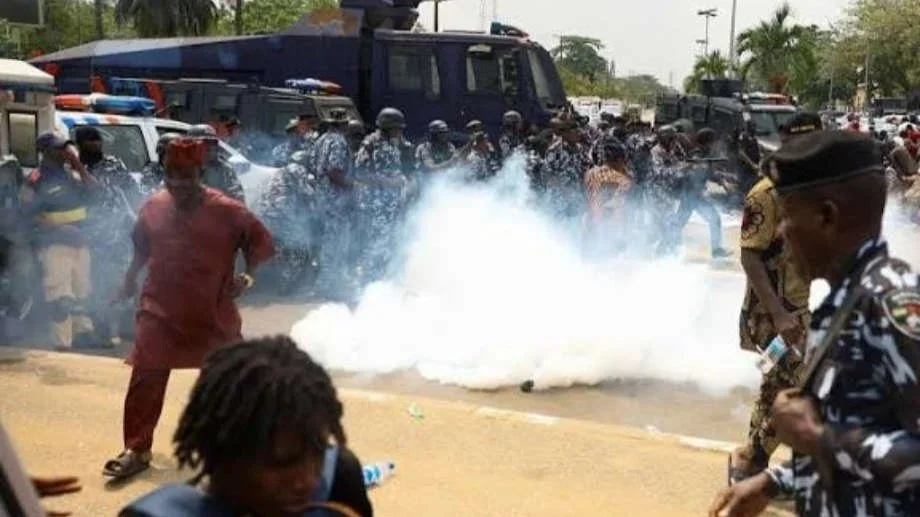
Lagos State Police Command deployed teargas to disperse hundreds of residents protesting
Operatives of the Lagos State Police Command deployed teargas canisters on Wednesday to disperse hundreds of residents protesting ongoing demolition exercises across several coastal and market communities. The demonstrators, representing affected areas including Makoko, Owode Onirin, Oworonshoki, Otumara, and Baba-Ijora, had gathered at the Lagos State House of Assembly in Ikeja to demand an immediate cessation of forced evictions and the provision of adequate resettlement plans.
Escalation at the Assembly Complex
The protest, which commenced at the Ikeja under-bridge, proceeded to the House of Assembly where participants displayed placards with inscriptions such as “Justice for Owode Onirin Traders” and “Governor Sanwo-Olu, Save Ajegunle People.” The residents alleged that the state government-led demolitions were executed without sufficient prior consultation, legal notice, or compensation for lost property and livelihoods.
Upon arrival at the assembly complex, the crowd was met by a heavy police blockade. Commissioner of Police Moshood Jimoh, present at the scene, cited security concerns for the restriction, stating that the measures were necessary to prevent the demonstration from being hijacked by hoodlums. Despite these assertions, protesters, led by activists including Hassan Soweto, argued for their right to access the designated assembly podium, citing recent precedents where other groups were permitted to protest peacefully.
Breakdown of Dialogue and Use of Force
The situation reached a flashpoint after three members of the Lagos State House of Assembly emerged to address the protesters. The crowd, dissatisfied with the lawmakers' response, reportedly booed the officials, leading to an abrupt end to the dialogue. Following the departure of the lawmakers, police moved to disperse the gathering using teargas.
The deployment resulted in several injuries and the arrest of multiple participants. Media personnel covering the event were also affected by the chemical irritants. Civil society groups have since condemned the use of force, emphasizing that the residents were exercising their fundamental rights to seek redress for the loss of their homes and businesses.
The Urban Renewal vs. Human Rights Debate
The incident highlights the intensifying friction between the Lagos State Government’s urban renewal agenda and the rights of low-income populations. While authorities maintain that the demolitions are necessary to enforce urban planning regulations and remove illegal structures in flood-prone or high-security zones, critics argue the implementation is heavy-handed.
Local analysts point to several critical gaps in the current approach:
Lack of Resettlement: Many of the affected areas, such as Makoko and Ajegunle, house vulnerable populations with no alternative housing options.
Economic Disruption: The demolition of informal markets like Owode Onirin strips thousands of traders of their primary source of income without a transition plan.
Inadequate Consultation: Communities claim that "engagement" often lacks transparency and fails to include vulnerable stakeholders in the decision making process.
The confrontation at the State House of Assembly serves as a stark reminder of the social costs associated with rapid urban modernization. As Lagos continues its push for infrastructural upgrades, the government faces increasing pressure to adopt more humane and inclusive strategies. Experts suggest that without a clear framework for compensation and resettlement, the drive for a "Mega City" status may continue to be marred by social unrest and a deepening trust deficit between the citizenry and the state.
