
Court Grants Malami Family ₦200m Bail Over Alleged ₦8.1bn Money Laundering
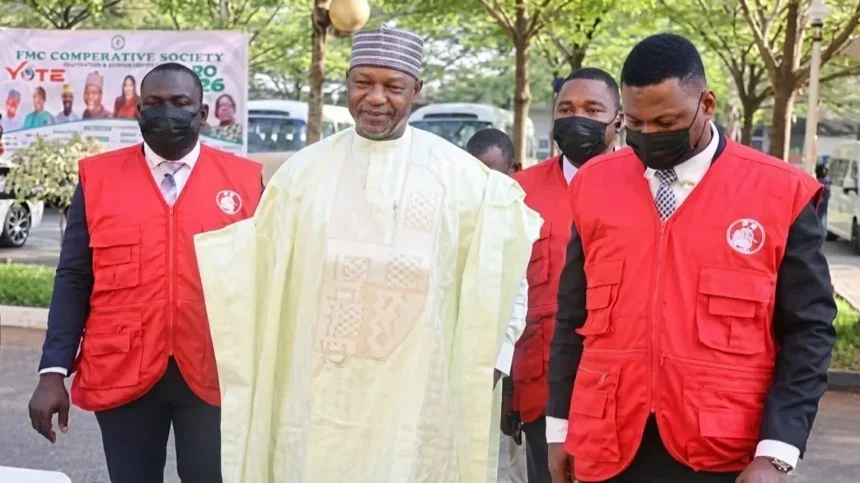
Abuja Court Grants Bail to Malami Family as ₦8.1bn Fraud Trial Begins
A Federal High Court in Abuja has granted bail to former Attorney-General of the Federation Abubakar Malami, his wife Asabe Bashir, and their son Abdulaziz Malami in a case involving alleged ₦8.1 billion money laundering charges.
The court ruled that each of the defendants must post ₦200 million bail with two sureties in like sum while the trial continues. The ruling was delivered by Justice Binta Nyako of the Federal High Court in Abuja.
The charges were filed by Nigeria’s anti-corruption agency, the Economic and Financial Crimes Commission (EFCC), which alleges that the defendants engaged in financial transactions designed to conceal the origin of illicit funds.
Bail Conditions and Court Orders
As part of the bail conditions, the court ordered that one of the sureties must present title documents of a property located in either Maitama or Asokoro, two high-value districts in Abuja.
The defendants were also instructed to deposit their international passports with the court, pending the conclusion of the trial.
Justice Nyako further ruled that the defendants would remain in the custody of the Nigerian Correctional Service until all bail conditions are fulfilled.
EFCC Allegations
The EFCC re-arraigned the defendants on a 16-count charge bordering on conspiracy and money laundering. Prosecutors allege that the Malami family laundered more than ₦8.1 billion between 2015 and 2025 through multiple bank accounts and corporate entities.
According to the anti-graft agency, the funds were allegedly moved through companies linked to the family, including Metropolitan Auto Tech Limited and Meethaq Hotels Limited, across several commercial banks.
Investigators claim the financial transactions were structured to disguise the origin and ownership of the funds, thereby avoiding regulatory scrutiny and anti-money-laundering controls.
Properties and Financial Transactions Under Investigation
Prosecutors also allege that a portion of the funds was used to acquire high-value residential and commercial properties in several Nigerian states, including Abuja, Kano and Kebbi.
Investigators claim that about ₦600 million of the funds was retained as cash collateral for banking facilities while the alleged illicit funds remained under the control of the defendants.
Authorities argue that these transactions formed part of a broader scheme designed to conceal the origin of the funds through complex financial structures and corporate entities.
Background to the Case
The case represents one of the most prominent corruption prosecutions involving a former senior government official in Nigeria.
Abubakar Malami served as Attorney-General of the Federation and Minister of Justice from 2015 to 2023, during the administration of former President Muhammadu Buhari.
Nigeria’s anti-corruption agencies have in recent years intensified investigations into financial crimes involving public officials, as part of broader efforts to strengthen transparency and accountability in public administration.
Outlook for the Trial
The court is expected to continue hearing the case in the coming months as prosecutors present evidence to support the money-laundering allegations.
Legal analysts note that the trial will likely examine complex financial transactions, corporate structures and property acquisitions linked to the defendants.
The outcome of the case could carry significant implications for Nigeria’s ongoing anti-corruption efforts and the enforcement of financial crime laws involving high-profile public figures.
